Showing posts with label India. Show all posts

Monday, 1 August 2022

DESKTOP 3284 - TAJ MAHAL

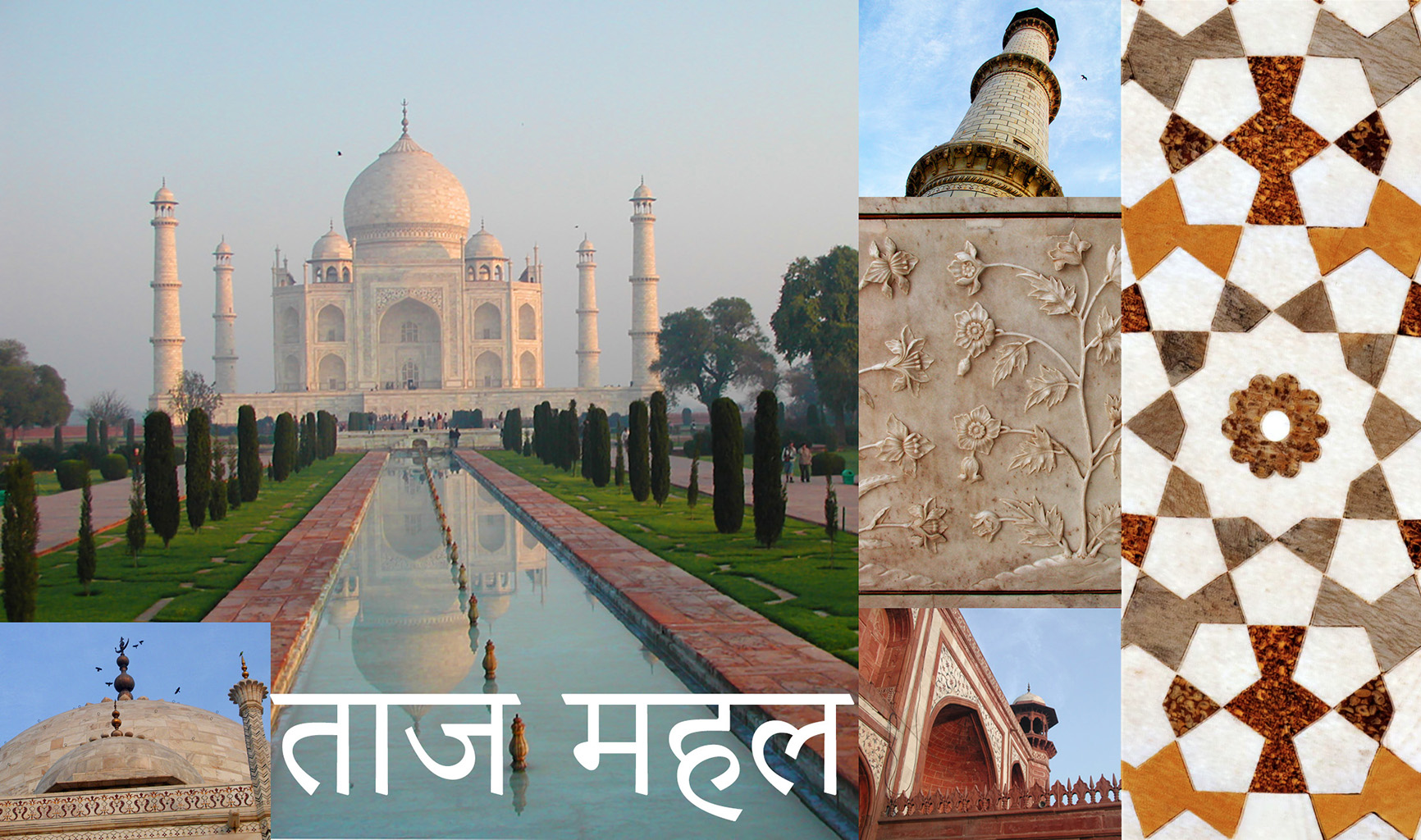
The Taj Mahal is a white Marble mausoleum located in Agra, India. It was built by Mughal emperor Shah Jahan in memory of his third wife, Mumtaz Mahal. The Taj Mahal is widely recognised as the jewel of Muslim art in India and one of the universally admired masterpieces of the world's heritage. The Taj Mahal is the finest example of Mughal architecture, a style that combines elements from Persian, Turkish and Indian architectural styles.

This post is part of the Mosaic Monday meme,
and also part of the Blue Monday meme,
and also part of the Seasons meme.


Saturday, 2 May 2020

DESKTOP 2466 - TAJ MAHAL, DAWN

One of the highlights of any visit to India is seeing the Taj Mahal in Agra. This is a white marble mausoleum built by Mughal emperor Shah Jahan in memory of his third wife, Mumtaz Mahal. The Taj Mahal is widely recognized as "the jewel of Muslim art in India and one of the universally admired masterpieces of the world's heritage". It covers an area of about 1003 acres or 405 hectares.

Taj Mahal is the finest example of Mughal architecture, a style that combines elements from Persian, Turkish and Indian architectural styles. In 1983, the Taj Mahal became a UNESCO World Heritage Site. While the white domed marble mausoleum is the most familiar component of the Taj Mahal, it is actually an integrated complex of structures.

The construction began around 1632 and was completed around 1653, employing thousands of artisans and craftsmen. The construction of the Taj Mahal was entrusted to a board of architects under imperial supervision, including Abd ul-Karim Ma'mur Khan, Makramat Khan, and Ustad Ahmad Lahauri. Lahauri is generally considered to be the principal designer.

This post is part of the Weekend Reflections meme.

Tuesday, 15 October 2019

DESKTOP 2265 - NEW DELHI, INDIA

New Delhi is the capital of India and one of Delhi city’s 11 districts. Although colloquially Delhi and New Delhi are used interchangeably to refer to the National Capital Territory of Delhi, these are two distinct entities, with New Delhi forming a small part of Delhi. The National Capital Region is a much larger entity comprising the entire National Capital Territory of Delhi along with adjoining districts.

The Akshardham or Swaminarayan Akshardham complex (seen below) is a Hindu mandir, and a spiritual-cultural campus in New Delhi, India. Also referred to as Akshardham Temple or Swaminarayan Akshardham, the complex displays millennia of traditional Hindu and Indian culture, spirituality, and architecture. The temple, which attracts approximately 70 percent of all tourists who visit Delhi, was officially opened on 6 November 2005 by Dr. A. P. J. Abdul Kalam. It sits near the banks of the Yamuna River adjacent to the 2010 Commonwealth Games village in eastern New Delhi. The temple, at the centre of the complex, was built according to the Vastu shastra and Pancharatra shastra.

This post is part of the Our World Tuesday meme,
and also part of the Travel Tuesday meme,
and also part of the Wordless Wednesday meme.

Tuesday, 23 July 2019

DESKTOP 2182 - GOLDEN TEMPLE, INDIA

Sri Harmandir Sahib (The abode of God), also Sri Darbar Sahib and informally referred to as the “Golden Temple”, is the holiest Gurdwara (place of worship) of Sikhism, located in the city of Amritsar, Punjab, India. Amritsar (literally, the tank of nectar of immortality) was founded in 1577 by the fourth Sikh guru, Guru Ram Das. The fifth Sikh Guru, Guru Arjan, designed the Harmandir Sahib to be built in the centre of this holy tank, and upon its construction, installed the Adi Granth, the holy scripture of Sikhism, inside the Harmandir Sahib.

The Harmandir Sahib complex is also home to the Akal Takht (the throne of the timeless one, constituted by the Sixth Guru, Guru Hargobind). While the Harmandir Sahib is regarded as the abode of God's spiritual attribute, the Akal Takht is the seat of God's temporal authority. The construction of Harmandir Sahib was intended to build a place of worship for men and women from all walks of life and all religions to come and worship God equally. Accordingly, as a gesture of this non-sectarian universalness of Sikhism, Guru Arjan had specially invited Muslim Sufi saint, Hazrat Mian Mir to lay the foundation stone of the Harmandir Sahib. The four entrances (representing the four directions) to get into the Harmandir Sahib also symbolise the openness of the Sikhs towards all people and religions.

Over 100,000 people visit the holy shrine daily for worship, and also partake jointly in the free community kitchen and meal (Langar) regardless of any distinctions, a tradition that is a hallmark of all Sikh Gurdwaras. The present-day gurdwara was renovated in 1764 by Jassa Singh Ahluwalia with the help of other Sikh Misls. In the early nineteenth century, Maharaja Ranjit Singh secured the Punjab region from outside attack and covered the upper floors of the gurdwara with gold, which gives it its distinctive appearance and its English name.

This post is part of the Our World Tuesday meme,
and also part of the Travel Tuesday meme,
and also part of the Wordless Wednesday meme.

Tuesday, 31 July 2018

DESKTOP 1826 - JANTAR MANTAR, INDIA

The Jantar Mantar is a collection of architectural astronomical instruments, built by Sawai Jai Singh who was a Rajput king. The title of (King) and Sawai was bestowed on him by Emperor Mohammad Shah. Jai Singh II of Amber built his new capital of Jaipur between 1727 and 1734. It is also located in Ujjain and Mathura. It is modelled after the one that he had built at the Mughal capital of Delhi.

He had constructed a total of five such facilities at different locations, including the ones at Delhi and Jaipur. The Jaipur observatory is the largest and best preserved of these. It has been inscribed on the World Heritage List as "an expression of the astronomical skills and cosmological concepts of the court of a scholarly prince at the end of the Mughal period".

Early restoration work was undertaken under the supervision of Major Arthur Garrett, a keen amateur astronomer, during his appointment as Assistant State Engineer for the Jaipur District. The Jantar Mantar was made by Sawai Jai Singh as he was particularly interested in learning about the sky above his head.

The name is derived from jantar ("instrument"), and mantar ("formula", or in this context "calculation"). Therefore jantar mantar means literally 'calculation instrument'. This observatory has religious significance, since ancient Indian astronomers were also Jyotisa (Indian astronomy and astrology) masters.

This post is part of the Our World Tuesday meme,
and also part of the Ruby Tuesday meme,
and also part of the Travel Tuesday meme,
and also part of the Wordless Wednesday meme.

Tuesday, 6 September 2016

DESKTOP 1134 - UDAIPUR, INDIA

Udaipur, also known as the City of Lakes, is a city, a Municipal Council and the administrative headquarters of the Udaipur district in the state of Rajasthan in western India. It is located 403 kilometres southwest of the state capital, Jaipur, 248 km west of Kota, and 250 km northeast from Ahmedabad.

Udaipur is the historic capital of the kingdom of Mewar in the former Rajputana Agency. The Guhils (Sisodia) clan ruled the Mewar and its capital was shifted from Chittorgarh to Udaipur after founding city of Udaipur by Maharana Uday Singh. The Mewar province became part of Rajasthan after India became independent.

Apart from its history, culture, and scenic locations, it is also known for its Rajput-era palaces. The Lake Palace, for instance, covers an entire island in the Pichola Lake. Many of the palaces have been converted into luxury hotels. It is often called the "Venice of the East", and is also nicknamed the "Lake City". Lake Pichola, Fateh Sagar Lake, Udai Sagar and Swaroop Sagar in this city are considered some of the most beautiful lakes in the state.

This post is part of the Our World Tuesday meme,
and also part of the Travel Tuesday meme,
and also part of the Wordless Wednesday meme.

Tuesday, 12 July 2016

DESKTOP 1078 - JAIPUR, INDIA

Jaipur is the capital and largest city of the Indian state of Rajasthan in Northern India. It was founded on 18 November 1727 by Maharaja Sawai Jai Singh II, the ruler of Amber, after whom the city is named. The city today has a population of 3.1 million. Jaipur is known as the Pink City of India. The city is unusual among pre-modern Indian cities in the regularity of its streets, and the division of the city into six sectors by broad streets 34 m wide. The urban quarters are further divided by networks of gridded streets. Five quarters wrap around the east, south, and west sides of a central palace quarter, with a sixth quarter immediately to the east.

The Palace quarter encloses the Hawa Mahal palace complex, formal gardens, and a small lake. Nahargarh Fort (show here), which was the residence of the King Sawai Jai Singh II, crowns the hill in the northwest corner of the old city. The observatory, Jantar Mantar, is one of the World Heritage Sites. Included on the Golden Triangle tourist circuit, along with Delhi and Agra, Jaipur is an extremely popular tourist destination in Rajasthan and India.

This post is part of the Our World Tuesday meme,
and also part of the Ruby Tuesday meme,
and also part of the Trees & Bushes meme,
and also part of the Travel Tuesday meme,
and also part of the Wordless Wednesday meme.

Wednesday, 1 June 2016

DESKTOP 1037 - UDAIPUR, INDIA

Udaipur, also known as the City of Lakes, is a city, a Municipal Council and the administrative headquarters of the Udaipur district in the state of Rajasthan in Western India. It is located 403 kilometres southwest of the state capital, Jaipur, 248 kilometres west of Kota, and 250 kilometres northeast from Ahmedabad. Udaipur was the historic capital of the former kingdom of Mewar in Rajputana Agency.

Apart from its history, culture, and scenic locations, it is also known for its Rajput-era palaces. The Lake Palace, for instance, covers an entire island in the Pichola Lake. Many of the palaces have been converted into luxury hotels. It is often called the "Venice of the East" and is also nicknamed the "Lake City". Lake Pichola, Fateh Sagar Lake, Udai Sagar and Swaroop Sagar in this city are considered some of the most beautiful lakes in the state.

This post is part of the Wednesday Waters meme,
and also part of the Waterworld Wednesday meme,
and also part of the Outdoor Wednesday meme,
and also part of the Wordless Wednesday meme,
and also part of the ABC Wednesday meme,
and also part of the Travel Tuesday meme.

Wednesday, 25 May 2016

DESKTOP 1030 - TAJ MAHAL

The Taj Mahal (Persian for 'Crown of Palaces') is an ivory-white marble mausoleum on the south bank of the Yamuna river in the Indian city of Agra. It was commissioned in 1632 by the Mughal emperor, Shah Jahan (reigned 1628–1658), to house the tomb of his favorite wife, Mumtaz Mahal. The tomb is the centrepiece of a 42-acre complex, which includes a mosque and a guest house, and is set in formal gardens bounded on three sides by a crenellated wall.

Construction of the mausoleum was essentially completed in 1643 but work continued on other phases of the project for another 10 years. The Taj Mahal complex is believed to have been completed in its entirety in 1653 at a cost estimated at the time to be around 32 million rupees, which in 2015 would be approximately 52.8 billion rupees (US$827 million). The construction project employed some 20,000 artisans under the guidance of a board of architects led by the court architect to the emperor, Ustad Ahmad Lahauri.

The Taj Mahal was designated as a UNESCO World Heritage Site in 1983 for being "the jewel of Muslim art in India and one of the universally admired masterpieces of the world's heritage". Described by Nobel laureate Rabindranath Tagore as "the tear-drop on the cheek of time", it is regarded by many as the best example of Mughal architecture and a symbol of India's rich history. The Taj Mahal attracts 7–8 million visitors a year. In 2007, it was declared a winner of the 'New 7 Wonders of the World' (2000–2007) initiative.

This post is part of the Wednesday Waters meme,
and also part of the Waterworld Wednesday meme,
and also part of the Outdoor Wednesday meme,
and also part of the Wordless Wednesday meme,
and also part of the ABC Wednesday meme.

Tuesday, 23 February 2016

DESKTOP 938 - HAWA MAHAL, JAIPUR

Hawa Mahal ("Palace of Winds" or "Palace of the Breeze"), is a palace in Jaipur, India. Built of red and pink sandstone, the palace forms a part of the City Palace, and extends to the zenana, or women's chambers. It was built in 1799 by Maharaja Sawai Pratap Singh, and designed by Lal Chand Ustad in the form of the crown of Krishna, the Hindu god. Its unique five-storey exterior is also akin to the honeycomb of the beehive with its 953 small windows called jharokhas that are decorated with intricate latticework. The original intention of the lattice was to allow royal ladies to observe everyday life in the street below without being seen, since they had to observe strict "purdah" (face cover). Besides this, the lattice also provides cool air caused by the Venturi effect (doctor breeze) through the intricate pattern and thereby air conditioning the whole area during the high temperatures in summers.

This post is part of the Travel Tuesday meme,
and also part of the Ruby Tuesday meme,
and also part of the Our World Tuesday meme,
and also part of the Wordless Wednesday meme.

Tuesday, 5 January 2016

DESKTOP 889 - INDIAN PAINTING

Indian painting has a very long tradition and history in Indian art. The earliest Indian paintings were the rock paintings of pre-historic times, the petroglyphs as found in places like Bhimbetka rock shelters, some of the Stone Age rock paintings found among the Bhimbetka rock shelters are approximately 30,000 years old.

India's Buddhist literature is replete with examples of texts which describe palaces of the army and the aristocratic class embellished with paintings, but the paintings of the Ajanta Caves are the most significant of the few survivals. Smaller scale painting in manuscripts was probably also practiced in this period, though the earliest survivals are from the medieval period.

Mughal painting represented a fusion of the Persian miniature with older Indian traditions, and from the 17th century its style was diffused across Indian princely courts of all religions, each developing a local style. Company paintings were made for British clients under the British Raj, which from the 19th century also introduced art schools along Western lines, leading to modern Indian painting, which is increasingly returning to its Indian roots.

Indian paintings provide an aesthetic continuum that extends from the early civilisation to the present day. From being essentially religious in purpose in the beginning, Indian painting has evolved over the years to become a fusion of various cultures and traditions.

This post is part of the Our World Tuesday meme,
and also part of the Ruby Tuesday meme,
and also part of the Travel Tuesday meme,
and also part of the Wordless Wednesday meme.