Showing posts with label temple. Show all posts

Tuesday, 7 July 2020

DESKTOP 2532 - PRAMBANAN TEMPLE, JAVA

Prambanan or Rara Jonggrang (Javanese: ꦫꦫꦗꦺꦴꦁꦒꦿꦁ, romanized: Rara Jonggrang) is a 9th-century Hindu temple compound in Special Region of Yogyakarta, Indonesia, dedicated to the Trimūrti, the expression of God as the Creator (Brahma), the Preserver (Vishnu) and the Transformer (Shiva). The temple compound is located approximately 17 kilometres (11 mi) northeast of the city of Yogyakarta on the boundary between Central Java and Yogyakarta provinces.

The temple compound, a UNESCO World Heritage Site, is the largest Hindu temple site in Indonesia and the second-largest in Southeast Asia. It is characterized by its tall and pointed architecture, typical of Hindu architecture, and by the towering 47-metre-high (154 ft) central building inside a large complex of individual temples. Prambanan attracts many visitors from around the world.

This post is part of the Our World Tuesday meme,
and also part of the Travel Tuesday meme,
and also part of the Wordless Wednesday meme.

Tuesday, 18 February 2020

DESKTOP 2392 - ABU SIMBEL

The Abu Simbel temples are two massive rock temples at Abu Simbel (أبو سمبل in Arabic), a village in Nubia, southern Egypt, near the border with Sudan. They are situated on the western bank of Lake Nasser, about 230 km southwest of Aswan (about 300 km by road). 

The complex is part of the UNESCO World Heritage Site known as the "Nubian Monuments," which run from Abu Simbel downriver to Philae (near Aswan). The twin temples were originally carved out of the mountainside during the reign of Pharaoh Ramesses II in the 13th century BC, as a lasting monument to himself and his queen Nefertari, to commemorate his victory at the Battle of Kadesh.

Their huge external rock relief figures have become iconic. The complex was relocated in its entirety in 1968, on an artificial hill made from a domed structure, high above the Aswan High Dam reservoir. The relocation of the temples was necessary to prevent their being submerged during the creation of Lake Nasser, the massive artificial water reservoir formed after the building of the Aswan High Dam on the Nile River.

This post is part of the Our World Tuesday meme,
and also part of the Travel Tuesday meme,
and also part of the Wordless Wednesday meme.

Sunday, 22 December 2019

DESKTOP 2334 - BALI, INDONESIA

Pura Ulun Danu Bratan, or Pura Bratan, is a major Shivaite and water temple on Bali, Indonesia. The temple complex is located on the shores of Lake Bratan in the mountains near Bedugul. Water temples serve the entire region in the outflow area; downstream there are many smaller water temples that are specific to each irrigation association (subak). Built in 1633, this temple is used for offerings ceremony to the Balinese water, lake and river goddess Dewi Danu, due to the importance of Lake Bratan as a main source of irrigation in central Bali. The 11 stories of pelinggih meru dedicated for Shiva and his consort Parvathi. Buddha statue also present inside this temple.

Lake Bratan is known as the Lake of Holy Mountain due to the fertility of this area. Located 1200 m above sea level, it has a cold tropical climate. Every Tuesday, the piodalan ceremony takes place at the temple, to ensure good water supply to all the rice farmers in Bali. As the day progresses, the lake and its surroundings become crowded with tourists and paddle boats, so if you want to experience the temple in all its glory, start early in the morning, or stay back during the sunset, to capture the beauty in a relatively uncluttered milieu.

This post is part of the My Sunday Best meme.

Tuesday, 15 October 2019

DESKTOP 2265 - NEW DELHI, INDIA

New Delhi is the capital of India and one of Delhi city’s 11 districts. Although colloquially Delhi and New Delhi are used interchangeably to refer to the National Capital Territory of Delhi, these are two distinct entities, with New Delhi forming a small part of Delhi. The National Capital Region is a much larger entity comprising the entire National Capital Territory of Delhi along with adjoining districts.

The Akshardham or Swaminarayan Akshardham complex (seen below) is a Hindu mandir, and a spiritual-cultural campus in New Delhi, India. Also referred to as Akshardham Temple or Swaminarayan Akshardham, the complex displays millennia of traditional Hindu and Indian culture, spirituality, and architecture. The temple, which attracts approximately 70 percent of all tourists who visit Delhi, was officially opened on 6 November 2005 by Dr. A. P. J. Abdul Kalam. It sits near the banks of the Yamuna River adjacent to the 2010 Commonwealth Games village in eastern New Delhi. The temple, at the centre of the complex, was built according to the Vastu shastra and Pancharatra shastra.

This post is part of the Our World Tuesday meme,
and also part of the Travel Tuesday meme,
and also part of the Wordless Wednesday meme.

Tuesday, 20 August 2019

DESKTOP 2210 - LHASA, TIBET

Lhasa is a city and administrative capital of the Tibet Autonomous Region of China. The main urban area of Lhasa is roughly equivalent to the administrative borders of Chengguan District, which is part of the wider Lhasa prefecture-level city, an area formerly administered as a prefecture. Lhasa is the second most populous city on the Tibetan Plateau after Xining and, at an altitude of 3,490 metres, Lhasa is one of the highest cities in the world. The city has been the religious and administrative capital of Tibet since the mid-17th century. It contains many culturally significant Tibetan Buddhist sites such as the Potala Palace, Jokhang Temple and Norbulingka Palaces.

The Potala Palace (shown here) was the chief residence of the Dalai Lama until the 14th Dalai Lama fled to India during the 1959 Tibetan uprising. It is now a museum and World Heritage Site. The palace is named after Mount Potalaka, the mythical abode of the bodhisattva Avalokiteśvara. The 5th Dalai Lama started its construction in 1645 after one of his spiritual advisers, Konchog Chophel (died 1646), pointed out that the site was ideal as a seat of government, situated as it is between Drepung and Sera monasteries and the old city of Lhasa. It may overlay the remains of an earlier fortress called the White or Red Palace on the site, built by Songtsän Gampo in 637.

The building measures 400 metres east-west and 350 metres north-south, with sloping stone walls averaging 3 m thick, and 5 m thick at the base, and with copper poured into the foundations to help proof it against earthquakes. Thirteen stories of buildings (containing over 1,000 rooms, 10,000 shrines and about 200,000 statues) soar 117 metres on top of Marpo Ri, the "Red Hill", rising more than 300 m in total above the valley floor. Tradition has it that the three main hills of Lhasa represent the “Three Protectors of Tibet”: Chokpori, just to the south of the Potala, is the soul-mountain of Vajrapani; Pongwari that of Manjusri; and Marpori, the hill on which the Potala stands, represents Avalokiteśvara.

This post is part of the Our World Tuesday meme,
and also part of the Ruby Tuesday meme,
and also part of the Travel Tuesday meme,
and also part of the Wordless Wednesday meme.

Tuesday, 6 August 2019

DESKTOP 2196 - PAESTUM, ITALY

Paestum was a major ancient Greek city on the coast of the Tyrrhenian Sea in Magna Graecia (southern Italy). The ruins of Paestum are famous for their three ancient Greek temples in the Doric order, dating from about 600 to 450 BC, which are in a very good state of preservation. The city walls and amphitheatre are largely intact, and the bottom of the walls of many other structures remain, as well as paved roads.The site is open to the public, and there is a modern national museum within it, which also contains the finds from the associated Greek site of Foce del Sele. After its foundation by Greek colonists under the name of Poseidonia (Ancient Greek: Ποσειδωνία) it was eventually conquered by the local Lucanians and later the Romans. The Lucanians renamed it to Paistos and the Romans gave the city its current name.

As Pesto or Paestum, the town became a bishopric (now only titular), but it was abandoned in the Early Middle Ages, and left undisturbed and largely forgotten until the eighteenth century. Today the remains of the city are found in the modern frazione of Paestum, which is part of the comune of Capaccio in the Province of Salerno, Campania, Italy. The modern settlement, directly to the south of the archaeological site, is a popular seaside resort, with long sandy beaches.

Much the most celebrated features of the site today are the three large temples in the Archaic version of the Greek Doric order, dating from about 550 to 450 BC. All are typical of the period, with massive colonnades having a very pronounced entasis (widening as they go down), and very wide capitals resembling upturned mushrooms. Above the columns, only the second Temple of Hera retains most of its entablature, the other two having only the architrave in place. These were dedicated to Hera, Athena, and Poseidon (Juno, Minerva, and Neptune to the Romans), although previously they often have been identified otherwise, for example, as a basilica and a temple of Ceres (Greek Demeter), after eighteenth-century arguments.

The two temples of Hera are right next to each other, while the Temple of Athena is on the other side of the town centre. There were other temples, both Greek and Roman, which are far less well-preserved. Paestum is far from any sources of good marble. The three main temples had few stone reliefs, perhaps using painting instead. Painted terracotta was for some detailed parts of the structure. The large pieces of terracotta that have survived are in the museum.

The second Temple of Hera was built around 460–450 BC, just north of the first Hera Temple (seen in the back left of the photo). It was once mistakenly thought to be dedicated to Poseidon. The columns do not have the typical 20 flutes on each column, but have 24 flutes. The Temple of Hera II also has a wider column size and smaller intervals between columns.

The temple was also used to worship Zeus and another deity, whose identity is unknown. There are visible on the east side the remains of two altars, one large and one smaller. The smaller one is a Roman addition, built when a road leading to a Roman forum was cut through the larger one. It also is possible that the temple originally was dedicated to both Hera and Poseidon; some offertory statues found around the larger altar are thought to demonstrate this identification.

This post is part of the Our World Tuesday meme,
and also part of the Travel Tuesday meme,
and also part of the Wordless Wednesday meme.

Tuesday, 23 July 2019

DESKTOP 2182 - GOLDEN TEMPLE, INDIA

Sri Harmandir Sahib (The abode of God), also Sri Darbar Sahib and informally referred to as the “Golden Temple”, is the holiest Gurdwara (place of worship) of Sikhism, located in the city of Amritsar, Punjab, India. Amritsar (literally, the tank of nectar of immortality) was founded in 1577 by the fourth Sikh guru, Guru Ram Das. The fifth Sikh Guru, Guru Arjan, designed the Harmandir Sahib to be built in the centre of this holy tank, and upon its construction, installed the Adi Granth, the holy scripture of Sikhism, inside the Harmandir Sahib.

The Harmandir Sahib complex is also home to the Akal Takht (the throne of the timeless one, constituted by the Sixth Guru, Guru Hargobind). While the Harmandir Sahib is regarded as the abode of God's spiritual attribute, the Akal Takht is the seat of God's temporal authority. The construction of Harmandir Sahib was intended to build a place of worship for men and women from all walks of life and all religions to come and worship God equally. Accordingly, as a gesture of this non-sectarian universalness of Sikhism, Guru Arjan had specially invited Muslim Sufi saint, Hazrat Mian Mir to lay the foundation stone of the Harmandir Sahib. The four entrances (representing the four directions) to get into the Harmandir Sahib also symbolise the openness of the Sikhs towards all people and religions.

Over 100,000 people visit the holy shrine daily for worship, and also partake jointly in the free community kitchen and meal (Langar) regardless of any distinctions, a tradition that is a hallmark of all Sikh Gurdwaras. The present-day gurdwara was renovated in 1764 by Jassa Singh Ahluwalia with the help of other Sikh Misls. In the early nineteenth century, Maharaja Ranjit Singh secured the Punjab region from outside attack and covered the upper floors of the gurdwara with gold, which gives it its distinctive appearance and its English name.

This post is part of the Our World Tuesday meme,
and also part of the Travel Tuesday meme,
and also part of the Wordless Wednesday meme.

Tuesday, 28 May 2019

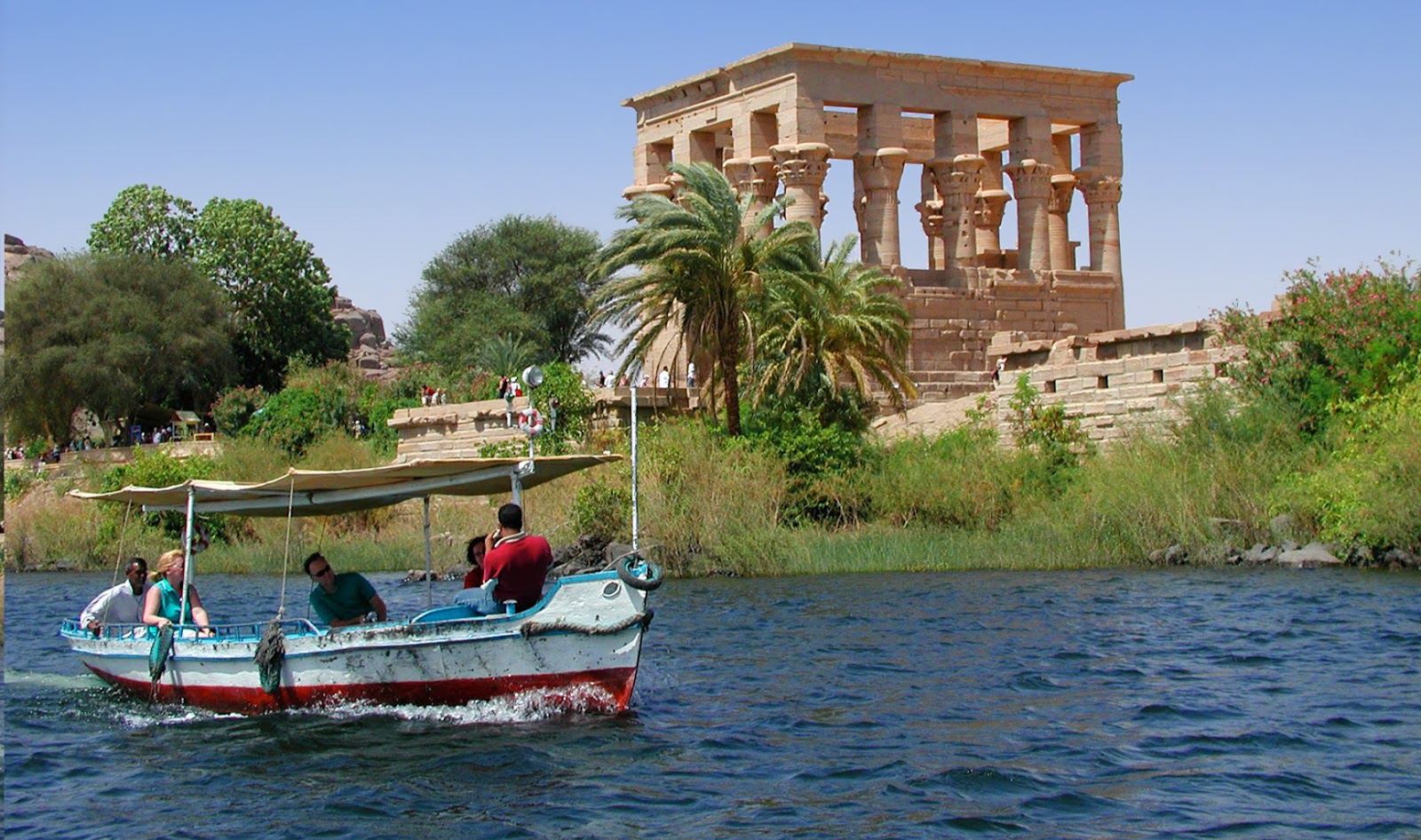
DESKTOP 2126 - PHILAE EGYPT

Philae (Greek: Φιλαί, Philai; Ancient Egyptian: Pilak, P'aaleq) is an island in Lake Nasser, Nubia. It was formerly an island in the First Cataract of the Nile River and the previous site of an Ancient Egyptian temple complex in southern Egypt. The complex was dismantled and relocated to nearby Agilkia Island during a UNESCO project started because of the construction of the Aswan Dam, after the site was partly flooded by the earlier Aswan Low Dam for half a century.

Monuments of various eras, extending from the Pharaohs to the Caesars, occupy nearly the whole area of Philae. The principal structures, however, lie at the south end of the smaller island. The most ancient were the remains of a temple for Isis built in the reign of Nectanebo I during 380-362 BC, was approached from the river through a double colonnade.

For the most part, the other ruins date from the Ptolemaic times, more especially with the reigns of Ptolemy Philadelphus, Ptolemy Epiphanes, and Ptolemy Philometor (282-145 BC), with many traces of Roman work in Philae dedicated to Ammon-Osiris. The island is reached by boat and visitors can wander around and admire the temples inside and out. No visit to Egypt is complete without visiting this amazing site.

This post is part of the Our World Tuesday meme,
and also part of the Ruby Tuesday meme,
and also part of the Travel Tuesday meme,
and also part of the Wordless Wednesday meme.

Sunday, 26 May 2019

DESKTOP 2124 - ACROPOLIS

Athens is one of the oldest named cities in the world, having been continuously inhabited for at least 5000 years. Situated in southern Europe, Athens became the leading city of Ancient Greece in the first millennium BC, and its cultural achievements during the 5th century BC laid the foundations of western civilisation.

During the early Middle Ages, the city experienced a decline, then recovered under the later Byzantine Empire and was relatively prosperous during the period of the Crusades (12th and 13th centuries), benefiting from Italian trade. Following a period of sharp decline under the rule of the Ottoman Empire, Athens re-emerged in the 19th century as the capital of the independent and self-governing Greek state.

Athens is rich in ancient sites and buildings, including the areopagus, the acropolis (seen below), the agora, various amphitheatres and various athenaea (temples of Athena, like the Parthenon), as well as numerous other architectural remains, and monuments, statuary and objects of everyday life. The Acropolis Museum, the National Archaeological Museum and numerous other museums and galleries also have objects and remains of the ancient city.

This post is part of the My Sunday Best meme.

Tuesday, 12 March 2019

DESKTOP 2049 - PAESTUM, ITALY

Paestum was a major ancient Greek city on the coast of the Tyrrhenian Sea in Magna Graecia (southern Italy). The ruins of Paestum are famous for their three ancient Greek temples in the Doric order, dating from about 600 to 450 BC, which are in a very good state of preservation. The city walls and amphitheatre are largely intact, and the bottom of the walls of many other structures remain, as well as paved roads.The site is open to the public, and there is a modern national museum within it, which also contains the finds from the associated Greek site of Foce del Sele.

After its foundation by Greek colonists under the name of Poseidonia (Ancient Greek: Ποσειδωνία) it was eventually conquered by the local Lucanians and later the Romans. The Lucanians renamed it to Paistos and the Romans gave the city its current name.As Pesto or Paestum, the town became a bishopric (now only titular), but it was abandoned in the Early Middle Ages, and left undisturbed and largely forgotten until the eighteenth century. 

Much the most celebrated features of the site today are the three large temples in the Archaic version of the Greek Doric order, dating from about 550 to 450 BC. All are typical of the period, with massive colonnades having a very pronounced entasis (widening as they go down), and very wide capitals resembling upturned mushrooms. Above the columns, only the second Temple of Hera retains most of its entablature, the other two having only the architrave in place. These were dedicated to Hera, Athena, and Poseidon (Juno, Minerva, and Neptune to the Romans), although previously they often have been identified otherwise, for example, as a basilica and a temple of Ceres (Greek Demeter), after eighteenth-century arguments.

This post is part of the Our World Tuesday meme,
and also part of the Travel Tuesday meme,
and also part of the Wordless Wednesday meme.

Sunday, 17 September 2017

DESKTOP 1510 - SOUNION TEMPLE

Cape Sounion (Modern Greek: Aκρωτήριο Σούνιο, transliterated Akrotírio Soúnio) is a promontory located 69 kilometres south-southeast of Athens, at the southernmost tip of the Attica peninsula in Greece. Cape Sounion is noted as the site of ruins of an ancient Greek temple of Poseidon, the god of the sea in classical mythology.

The remains are perched on the headland, surrounded on three sides by the sea. The ruins bear the deeply engraved name of English Romantic poet Lord Byron (1788–1823). The site is a popular day-excursion for tourists from Athens, with the sunset over the Aegean Sea, as viewed from the ruins, a sought-after spectacle.

This post is part of the My Sunday Best meme,
and also part of the My Sunday Photo meme,
and also part of the Photo Sunday meme.

Tuesday, 1 August 2017

DESKTOP 1463 - BALI, INDONESIA

Bali is an island and province of Indonesia. The province includes the island of Bali and a few smaller neighbouring islands, notably Nusa Penida, Nusa Lembongan, and Nusa Ceningan. It is located at the westernmost end of the Lesser Sunda Islands, between Java to the west and Lombok to the east. Its capital, Denpasar, is located in the southern part of the island. With a population of 3,890,757 in the 2010 census, and 4,225,000 as of January 2014, the island is home to most of Indonesia's Hindu minority. According to the 2010 Census, 83.5% of Bali's population adhered to Balinese Hinduism, followed by 13.4% Muslim, Christianity at 2.5%, and Buddhism 0.5%.

Bali is a popular tourist destination, which has seen a significant rise in tourists since the 1980s. Tourism-related business makes up 80% of its economy. It is renowned for its highly developed arts, including traditional and modern dance, sculpture, painting, leather, metalworking, and music. The Indonesian International Film Festival is held every year in Bali. In March 2017, TripAdvisor named the island the world's top destination in its Traveler's choice award.

Bali is part of the Coral Triangle, the area with the highest biodiversity of marine species. In this area alone over 500 reef building coral species can be found. For comparison, this is about 7 times as many as in the entire Caribbean. Bali is also home to a unified confederation of kingdoms, composed of 10 traditional royal Balinese houses, where each house rules a specific geographic area. the confederation is the successor of the Bali Kingdom. The royal houses are not recognized by the government of Indonesia, however, they have been operational since their establishment prior to Dutch colonization.

Pura Ulun Danu Beratan, or Pura Bratan, is a major Shaivite water temple on Bali. The temple complex is located on the shores of Lake Bratan in the mountains near Bedugul. Water temples serve the entire region in the outflow area; downstream there are many smaller water temples that are specific to each irrigation association (subak). Built in 1633, this temple is used for offerings ceremony to the Balinese water, lake and river goddess Dewi Danu, due to the importance of Lake Bratan as a main source of irrigation in central Bali. The 11-storey pelinggih meru in the complex is dedicated to Shiva and his consort Parvathi. Buddha's statue is also enshrined in this temple.Lake Bratan is known as the Lake of Holy Mountain due to the fertility of this area. Located 1200 m above sea level, it has a cold tropical climate.

This post is part of the Our World Tuesday meme,
and also part of the Travel Tuesday meme,
and also part of the Wordless Wednesday meme.

Wednesday, 5 July 2017

DESKTOP 1436 - ZION

Zion (Hebrew: צִיּוֹן‎‎ Tsiyyon), also transliterated Sion, Sayon, Syon, Tzion or Tsion, is a placename often used as a synonym for Jerusalem. The word is first found in 2 Samuel 5:7 which dates from c.630–540 BC according to modern scholarship. It commonly referred to a specific mountain near Jerusalem (Mount Zion), on which stood a Jebusite fortress of the same name that was conquered by David and was named the City of David.

The term Tzion came to designate the area of Jerusalem where the fortress stood, and later became a metonym for Solomon's Temple, the city of Jerusalem and "the World to Come", the Jewish understanding of the afterlife. In Kabbalah, the more esoteric reference is made to Tzion being the spiritual point from which reality emerges, located in the Holy of Holies of the First, Second and Third Temple.

This post is part of the Outdoor Wednesday meme,
and also part of the Wordless Wednesday meme,
and also part of the ABC Wednesday meme.

Tuesday, 29 November 2016

DESKTOP 1218 - GREEK TEMPLE, SICILY

The Temple of Concordia (Italian: Tempio della Concordia) is an ancient Greek temple located in the Valle dei Templi (Valley of the Temples) in Agrigento (Greek: Akragas) on the southern coast of Sicily, Italy. It is the largest and best-preserved Doric temple in Sicily and one of the best-preserved Greek temples in general, especially of the Doric order.

The temple was built c. 440–430 BC. The well-preserved peristasis of six by thirteen columns stands on top of a crepidoma of four steps (measuring 39.42 m × 16.92 m), and 8.93 m high). The cella measures 28.36 m × 9.4 m. The columns are 6 m high and carved with twenty flutes and harmonious entasis (tapering at the tops of the columns and swelling around the middles). It is constructed, like the nearby Temple of Juno, on a solid base designed to overcome the unevenness of the rocky terrain.

It has been conventionally named after Concordia, the Roman goddess of harmony, for the Roman-era Latin inscription found nearby, which is unconnected with it. The temple was converted into a Christian basilica in the 6th century dedicated to the apostles Peter and Paul by San Gregorio delle Rape, bishop of Agrigento and thus survived the destruction of pagan places of worship. The spaces between the columns were filled with walling, altering its Classical Greek form. The division between the cella, the main room where the cult statue would have stood in antiquity, and the opisthodomos, an adjoining room, was destroyed, and the walls of the cella were cut into a series of arches along the nave.

The Christian refurbishments were removed during the restoration of 1785. According to another source, the Prince of Torremuzza transferred the altar elsewhere and began restoration of the classic building in 1788. According to authors of a 2007 article, it is "apart from the Parthenon, the best preserved Doric temple in the world.

This post is part of the Our World Tuesday meme,
and also part of the Travel Tuesday meme,
and also part of the Wordless Wednesday meme.

Tuesday, 11 October 2016

DESKTOP 1169 - THESSEION, ATHENS

On the North side of the Western section of the Agora of ancient Athens stands the temple of the Thesseion, one of the best preserved ancient temples in Greece. It was built about 449 BC, by the architect Ictinus (who also designed the Parthenon on the Acropolis). The Thesseion has 34 Doric columns and its frieze depicts the labours of Hercules.

Originally dedicated to Hephaestus, the god of metallurgy and the practical crafts, the temple was surrounded by forges and foundries. In the Roman period it was surrounded by gardens. During the 14th century AD, the temple was converted into the church of St George. It is now restored and is part of the archaeological site of the ancient Athenian Agora.

This post is part of the Our World Tuesday meme,
and also part of the Ruby Tuesday meme,
and also part of the Travel Tuesday meme,
and also part of the Wordless Wednesday meme.