Showing posts with label Asia. Show all posts

Thursday, 5 December 2019

DESKTOP 2317 - HYDRANGEA

Hydrangea (common names hydrangea or hortensia) is a genus of 70-75 species of flowering plants in the Hydrangeaceae family, native to southern and eastern Asia (China, Japan, Korea, the Himalayas, and Indonesia) and the Americas. By far the greatest species diversity is in eastern Asia, notably China, Japan, and Korea. Most are shrubs 1 to 3 meters tall, but some are small trees, and others lianas reaching up to 30 m by climbing up trees. 

They can be either deciduous or evergreen, though the widely cultivated temperate species are all deciduous. Having been introduced to the Azores, H. macrophylla is now very common, particularly on Faial, which is known as the "blue island" due to the vast number of hydrangeas present on the island. Species in the related genus Schizophragma, also in Hydrangeaceae, are also often known as hydrangeas. Schizophragma hydrangeoides and Hydrangea petiolaris are both commonly known as climbing hydrangeas.

This post is part of the Floral Friday Fotos meme.

Thursday, 21 November 2019

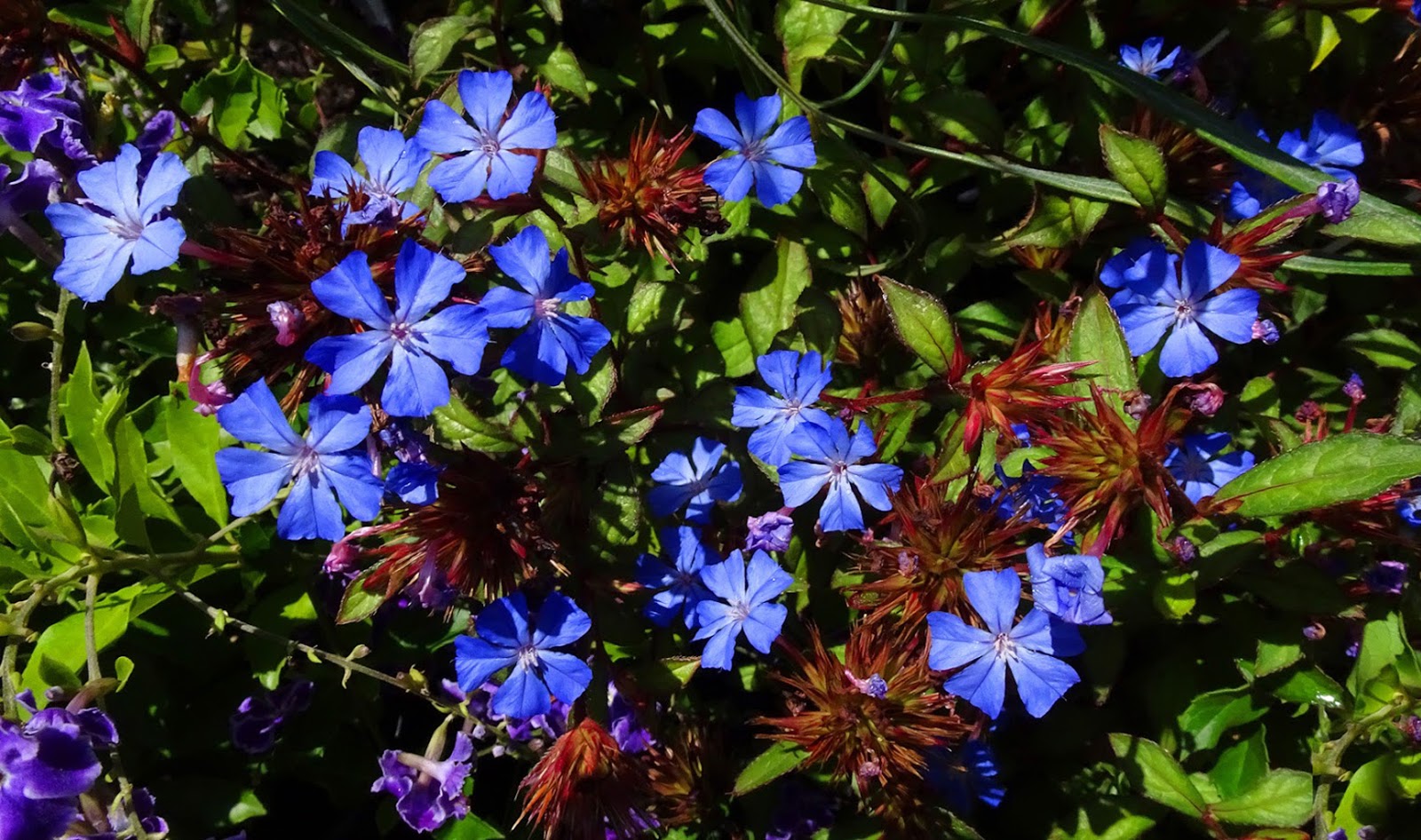
DESKTOP 2302 - CERATOSTIGMA

Ceratostigma, or leadwort, plumbago, is a genus of eight species of flowering plants in the family Plumbaginaceae, native to warm temperate to tropical regions of Africa and Asia. Common names are shared with the genus Plumbago. They are flowering herbaceous plants, subshrubs, or small shrubs growing to 0.3–1 m tall.

The leaves are spirally arranged, simple, 1–9 cm long, usually with a hairy margin. Some of the species are evergreen, others deciduous. The flowers are produced in a compact inflorescence, each flower with a five-lobed corolla; flower colour varies from pale to dark blue to red-purple. The fruit is a small bristly capsule containing a single seed.

Ceratostigma willmottianum shown here is a species of flowering plant native to western China and Tibet. It is an ornamental deciduous shrub that grows to 1 metre in height, with pale blue plumbago-like flowers appearing in autumn as the leaves start to turn red. Ceratostigma is derived from Greek, meaning 'horned stigma’. This is in reference to the ‘shape of the stigmatic surface’. Willmottianum was named for Miss Ellen Ann Willmott (1858-1934), a keen gardener and plant introducer from Warley Place, Essex.

This post is part of the Floral Friday Fotos meme.

Thursday, 10 October 2019

DESKTOP 2260 - BLUE PEA

Clitoria ternatea, common names including butterfly-pea, blue-pea, and cordofan-pea, is a plant species belonging to the Fabaceae family. The flowers of this vine have the shape of human female genitals, hence the Latin name of the genus Clitoria, from "clitoris". 

This plant is native to tropical equatorial Asia, but has been introduced to Africa, Australia and America. It is a perennial herbaceous plant, with elliptic, obtuse leaves. It grows as a vine or creeper, doing well in moist, neutral soil. The most striking feature about this plant are its vivid deep blue flowers; solitary, with light yellow markings. They are about 4 cm long by 3 cm wide. There are some varieties that yield white flowers. The fruits are 5 – 7 cm long, flat pods with 6 to 10 seeds in each pod. They are edible when tender.

It is grown as an ornamental plant and as a revegetation species (e.g., in coal mines in Australia), requiring little care when cultivated. As a legume, its roots form a symbiotic association with soil bacteria known as rhizobia, which transform atmospheric nitrogen gas into a plant usable form, therefore, this plant is also used to improve soil quality through the decomposition of nitrogen-rich tissue. In animal tests the methanolic extract of Clitoria ternatea roots demonstrated nootropic, anxiolytic, antidepressant, anticonvulsant and antistress activity. The active constituents include tannins, resins, starch, taraxerol and taraxerone. Other compounds form the pant have shown promise as antibiotics and anti-cancer agents.

This post is part of the Floral Friday Fotos meme.

Thursday, 3 October 2019

CAMELLIA

Camellia is a genus of flowering plants in the family Theaceae. They are found in eastern and southern Asia, from the Himalayas east to Japan and Indonesia. There are 100–250 described species, with some controversy over the exact number. The genus was named by Linnaeus after the Jesuit botanist Georg Joseph Kamel, who worked in the Philippines, though he never described a camellia.
 
This genus is famous throughout East Asia; camellias are known as cháhuā (茶花) in Chinese, "tea flower", an apt designation, as tsubaki (椿) in Japanese, as dongbaek-kkot (동백꽃) in Korean and as hoa trà or hoa chè in Vietnamese. Of economic importance in the Indian subcontinent and Asia, leaves of C. sinensis are processed to create the popular beverage, tea. The ornamental Camellia japonica, Camellia oleifera and Camellia sasanqua and their hybrids are represented in cultivation by a large number of cultivars.
 
This post is part of the Floral Friday Fotos meme.

Tuesday, 20 August 2019

DESKTOP 2210 - LHASA, TIBET

Lhasa is a city and administrative capital of the Tibet Autonomous Region of China. The main urban area of Lhasa is roughly equivalent to the administrative borders of Chengguan District, which is part of the wider Lhasa prefecture-level city, an area formerly administered as a prefecture. Lhasa is the second most populous city on the Tibetan Plateau after Xining and, at an altitude of 3,490 metres, Lhasa is one of the highest cities in the world. The city has been the religious and administrative capital of Tibet since the mid-17th century. It contains many culturally significant Tibetan Buddhist sites such as the Potala Palace, Jokhang Temple and Norbulingka Palaces.

The Potala Palace (shown here) was the chief residence of the Dalai Lama until the 14th Dalai Lama fled to India during the 1959 Tibetan uprising. It is now a museum and World Heritage Site. The palace is named after Mount Potalaka, the mythical abode of the bodhisattva Avalokiteśvara. The 5th Dalai Lama started its construction in 1645 after one of his spiritual advisers, Konchog Chophel (died 1646), pointed out that the site was ideal as a seat of government, situated as it is between Drepung and Sera monasteries and the old city of Lhasa. It may overlay the remains of an earlier fortress called the White or Red Palace on the site, built by Songtsän Gampo in 637.

The building measures 400 metres east-west and 350 metres north-south, with sloping stone walls averaging 3 m thick, and 5 m thick at the base, and with copper poured into the foundations to help proof it against earthquakes. Thirteen stories of buildings (containing over 1,000 rooms, 10,000 shrines and about 200,000 statues) soar 117 metres on top of Marpo Ri, the "Red Hill", rising more than 300 m in total above the valley floor. Tradition has it that the three main hills of Lhasa represent the “Three Protectors of Tibet”: Chokpori, just to the south of the Potala, is the soul-mountain of Vajrapani; Pongwari that of Manjusri; and Marpori, the hill on which the Potala stands, represents Avalokiteśvara.

This post is part of the Our World Tuesday meme,
and also part of the Ruby Tuesday meme,
and also part of the Travel Tuesday meme,
and also part of the Wordless Wednesday meme.

Thursday, 15 August 2019

DESKTOP 2205 - BLUE PEA

Clitoria ternatea, common names including butterfly-pea, blue-pea, and cordofan-pea, is a plant species belonging to the Fabaceae family. The flowers of this vine have the shape of human female genitals, hence the Latin name of the genus Clitoria, from "clitoris". This plant is native to tropical equatorial Asia, but has been introduced to Africa, Australia and America.

It is a perennial herbaceous plant, with elliptic, obtuse leaves. It grows as a vine or creeper, doing well in moist, neutral soil. The most striking feature about this plant are its vivid deep blue flowers; solitary, with light yellow markings. They are about 4 cm long by 3 cm wide. There are some varieties that yield white flowers. The fruits are 5 – 7 cm long, flat pods with 6 to 10 seeds in each pod. They are edible when tender. It is grown as an ornamental plant and as a revegetation species (e.g., in coal mines in Australia), requiring little care when cultivated.

As a legume, its roots form a symbiotic association with soil bacteria known as rhizobia, which transform atmospheric nitrogen gas into a plant usable form, therefore, this plant is also used to improve soil quality through the decomposition of nitrogen-rich tissue. In animal tests the methanolic extract of Clitoria ternatea roots demonstrated nootropic, anxiolytic, antidepressant, anticonvulsant and antistress activity. The active constituents include tannins, resins, starch, taraxerol and taraxerone. Other compounds form the pant have shown promise as antibiotics and anti-cancer agents.

This post is part of the Floral Friday Fotos meme.

Thursday, 2 May 2019

DESKTOP 2100 - CASSIA

Cassia fistula, known as the golden shower tree and by other names, is a flowering plant in the family Fabaceae. The species is native to the Indian subcontinent and adjacent regions of Southeast Asia. It ranges from southern Pakistan eastward throughout India to Myanmar and Thailand and south to Sri Lanka. In literature, it is closely associated with the Mullai (forest) region of Sangam landscape. It is the national tree of Thailand, and its flower is Thailand's national flower. It is also the state flower of Kerala in India and of immense importance amongst the Malayali population. It is a popular ornamental plant and is also used in herbal medicine.

The golden shower tree is a medium-sized tree, growing to 10–20 m tall with fast growth. The leaves are deciduous, 15–60 cm long, and pinnate with three to eight pairs of leaflets, each leaflet 7–21 cm long and 4–9 cm broad. The fragrant flowers are produced in pendulous racemes 20–40 cm long, each flower 4–7 cm diameter with five yellow petals of equal size and shape. The fruit is a legume, 30–60 cm long and 1.5–2.5 centimetres broad, with a pungent odour and containing several seeds. The tree has strong and very durable wood.

Cassia fistula is widely grown as an ornamental plant in tropical and subtropical areas. It blooms in late spring. Flowering is profuse, with trees being covered with yellow flowers, many times with almost no leaf being seen. It will grow well in dry climates. Growth for this tree is best in full sun on well-drained soil; it is relatively drought tolerant and slightly salt tolerant. It will tolerate light brief frost, but can get damaged if the cold persists. It can be subject to mildew or leaf spot, especially during the second half of the growing season. The tree will bloom better where there is pronounced difference between summer and winter temperatures.

In Ayurvedic medicine, the golden shower tree is known as aragvadha, meaning "disease killer". The fruit pulp is considered a purgative, and self-medication or any use without medical supervision is strongly advised against in Ayurvedic texts. Though its use in herbalism has been attested to for millennia, little research has been conducted in modern times.

This post is part of the Floral Friday Fotos meme.

Thursday, 21 March 2019

DESKTOP 2058 - JAPANESE ANEMONE

Anemone hupehensis, Anemone hupehensis var. japonica, and Anemone × hybrida (commonly known as the Chinese anemone or Japanese anemone, thimbleweed, or windflower) are species of flowering herbaceous perennials in the Ranunculaceae family.

A. hupehensis is native to central China, though it has been naturalised in Japan for hundreds of years. The species was first named and described in Flora Japonica (1784), by Carl Thunberg. Thunberg had collected dried specimens while working as a doctor for the Dutch East Indies Company. In 1844, Robert Fortune brought the plant to England from China, where he found it often planted about graves.
 
Height is 1–1.5 m and the leaves have three leaflets. Flowers are 40–60 mm across, with 5-6 (or up to 20 in double forms) sculpted pink or white petals and prominent yellow stamens, blooming from midsummer to autumn. These plants thrive best in shady areas and under protection of larger plants. They are especially sensitive to drought or overwatering. They can be invasive or weedy in some areas, throwing out suckers from the fibrous rootstock, to rapidly colonise an area. Once established they can be extremely difficult to eradicate. On the other hand, they can take some time to become established.

This post is part of the Floral Friday Fotos meme.

Thursday, 14 February 2019

DESKTOP 2023 - STAR ANISE

Illicium anisatum, commonly known as the Japanese star anise, is a tree similar to Chinese star anise. It is highly toxic, therefore it is not edible; instead, it has been burned as incense in Japan, where it is known as shikimi. Cases of illness, including serious neurological effects such as seizures, reported after using star anise tea may be a result of using this species.

I. anisatum is native to Japan. It is similar to I. verum, but its fruit is smaller and with weaker odour, which is said to be more similar to cardamom than to anise. While it is poisonous and therefore unsuitable for using internally, it is used for treatment of some skin problems in traditional Chinese medicine.

This post is part of the Floral Friday Fotos meme.

Thursday, 30 August 2018

DESKTOP 1856 - MAGNOLIAS

Magnolia liliiflora (variously known by many names, including Mulan magnolia, purple magnolia, red magnolia, lily magnolia, tulip magnolia, Jane magnolia and woody-orchid) is a small tree native to southwest China (in Sichuan and Yunnan), but cultivated for centuries elsewhere in China and also Japan. It was first introduced to English-speaking countries from cultivated Japanese origins, and is thus also sometimes called Japanese magnolia, though it is not native to Japan. It is now also planted as an ornamental in North America and Europe, though rather less often than its popular hybrid (see below).

It is a deciduous shrub, exceptionally a small tree, to 4m tall (smaller than most other magnolias), and blooms profusely in early spring with large pink to purple showy flowers, before the leaf buds open.The cultivar 'Nigra', with flowers much deeper in colour than the species, has gained the Royal Horticultural Society's Award of Garden Merit.  This species is one of the parents of the very popular hybrid Saucer magnolia, M. × soulangeana, the other parent being the Yulan magnolia, M. denudata.

This post is part of the Floral Friday Fotos meme.

Thursday, 26 July 2018

DESKTOP 1821 - INDIAN HAWTHORN

Rhaphiolepis indica, the Indian hawthorn, India hawthorn or Hong Kong hawthorn, is an evergreen shrub in the family As. The species is native to an area from southern China, Japan, Laos, Cambodia, Thailand and Vietnam. It is grown for its decorative pink flowers, and is popular in bonsai culture. The fruit is edible when cooked, and can be used to make jam.

Indian hawthorn is a mainstay horticultural specimen in southern United States. It is often found in commercial as well as in private landscapes. Often it is trimmed into small compact hedges or balls for foundation plants. It has been successfully pruned into a standard form as well as small dwarf-like trees up to 5 m in height. It is apt to develop leaf spot.

This post is part of the Floral Friday Fotos meme.

Wednesday, 18 July 2018

DESKTOP 1814 - YELLOW JASMINE

Winter jasmine (Jasminum nudiflorum) is a slender, deciduous shrub native to China. It grows to 3 m tall and wide, with arching green shoots and opposite, pinnate, dark green leaves. Each leaf is divided into three oval-oblong leaflets which are about 3 cm long.As its name suggests, in the Northern Hemisphere winter jasmine flowers from November to March. The solitary flowers, often appearing on the bare stems (hence the Latin nudiflorum, literally "naked flower") have six petals and are bright yellow, or white, about 1 cm across, appearing in the leaf axils.

It likes full sun or partial shade and is hardy. J. nudiflorum is valued by gardeners as one of the few plants that are in flower during the winter months. It is frequently trained against a wall to provide extra warmth and shelter, but also lends itself to groundcover. It tolerates hard pruning and should be pruned in spring immediately after flowering; regular pruning will help to prevent bare patches. It can also be grown as a bonsai and is very tolerant of the wiring methods. It can be propagated using the layering technique. This plant has gained the Royal Horticultural Society's Award of Garden Merit.

This post is part of the Floral Friday Fotos meme.

Thursday, 22 February 2018

DESKTOP 1668 - PINK HIBISCUS

Hibiscus rosa-sinensis, known colloquially as Chinese hibiscus, China rose, Hawaiian hibiscus, and shoeblackplant, is a species of tropical hibiscus, a flowering plant in the Hibisceae tribe of the family Malvaceae, native to East Asia. Hibiscus rosa-sinensis is a bushy, evergreen shrub or small tree growing 2.5–5 m tall and 1.5–3 m wide, with glossy leaves and solitary, brilliant red flowers in summer and autumn. The 5-petaled flowers are 10 cm in diameter, with prominent orange-tipped red anthers.

Numerous hybrids have been developed in a variety of flower colours. This is one of many plant species with a genetic characteristic known as polyploidy, in which there are more than two complete sets of chromosomes, unlike most other species. A side effect of polyploidy is a condition where the appearance of the offspring may be quite different from the parent, or indeed any ancestor, essentially allowing possibly random expression of all (or any) of the characteristics of all the generations that have gone before. Because of this characteristic, H. rosa-sinensis has become popular with hobbyists who cross and recross varieties, creating new named varieties and holding competitions to exhibit and judge the many resulting new seedlings and often strikingly unique flowers.

The flowers of Hibiscus rosa-sinensis are edible and are used in salads in the Pacific Islands. The flower is additionally used in hair care as a preparation. It is also used to shine shoes in certain parts of India. They can also be used as a pH indicator. When used, the flower turns acidic solutions to a dark pink or magenta colour and basic solutions to green. It is also used for the worship of Devi, and the red variety is especially prominent, having an important part in tantra. In Indonesia, these flowers are called "kembang sepatu", which literally means "shoe flower". In several countries the flowers are dried to use in a beverage, usually tea.

The shrub is widely grown as an ornamental plant throughout the tropics and subtropics. As it does not tolerate temperatures below 10 °C, in temperate regions it is best grown under glass. However, plants in containers may be placed outside during the summer months or moved into shelter during the winter months.

This post is part of the Floral Friday Fotos meme.

Thursday, 23 November 2017

DESKTOP 1577 - HYDRANGEA

Hydrangea macrophylla is a species of flowering plant in the family Hydrangeaceae, native to Japan. It is a deciduous shrub growing to 2 m tall by 2.5 m broad with large heads of pink or blue flowers in summer and autumn. Common names include bigleaf hydrangea, French hydrangea, lacecap hydrangea, mophead hydrangea, penny mac and hortensia.

It is widely cultivated in many parts of the world in many climates. H. macrophylla blooms can be blue, red, pink, light purple, or dark purple. The colour is affected by soil pH. An acidic soil (pH below 7) will usually produce flower colour closer to blue, whereas an alkaline soil (pH above 7) will produce flowers more pink. This is caused by a colour change of the flower pigments in the presence of aluminium ions which can be taken up into hyperaccumulating plants. There are many proprietary 'bluing' chemicals that can be added to the soil around the plants to make the flowers blue.

This post is part of the Floral Friday Fotos meme.

Thursday, 21 September 2017

DESKTOP 1514 - RED CAMELLIA

Camellia is a genus of flowering plants in the family Theaceae. They are found in eastern and southern Asia, from the Himalayas east to Japan and Indonesia. There are 100–250 described species, with some controversy over the exact number. The genus was named by Linnaeus after the Jesuit botanist Georg Joseph Kamel, who worked in the Philippines, though he never described a camellia.

This genus is famous throughout East Asia; camellias are known as cháhuā (茶花) in Chinese, "tea flower", an apt designation, as tsubaki (椿) in Japanese, as dongbaek-kkot (동백꽃) in Korean and as hoa trà or hoa chè in Vietnamese. Of economic importance in the Indian subcontinent and Asia, leaves of C. sinensis are processed to create the popular beverage, tea. The ornamental Camellia japonica, Camellia oleifera and Camellia sasanqua and their hybrids are represented in cultivation by a large number of cultivars.

This post is part of the Floral Friday Fotos meme.

Thursday, 14 September 2017

DESKTOP 1507 - LOROPETALUM

Loropetalum is a genus of three species of shrubs or small trees in the witch-hazel family, Hamamelidaceae, native to China, Japan, and south-eastern Asia. The name Loropetalum refers to the shape of the flowers and comes from the Greek loron meaning strap and petalon meaning petal. Flowers are produced in clusters during spring and are similar to those of the closely related witch-hazel. Each flower consists of four to six (depending on species) slender strap shaped petals 1-2 cm long. Illustrated here is Loropetalum chinense var. rubrum.

This post is part of the Floral Friday Fotos meme.

Tuesday, 1 August 2017

DESKTOP 1463 - BALI, INDONESIA

Bali is an island and province of Indonesia. The province includes the island of Bali and a few smaller neighbouring islands, notably Nusa Penida, Nusa Lembongan, and Nusa Ceningan. It is located at the westernmost end of the Lesser Sunda Islands, between Java to the west and Lombok to the east. Its capital, Denpasar, is located in the southern part of the island. With a population of 3,890,757 in the 2010 census, and 4,225,000 as of January 2014, the island is home to most of Indonesia's Hindu minority. According to the 2010 Census, 83.5% of Bali's population adhered to Balinese Hinduism, followed by 13.4% Muslim, Christianity at 2.5%, and Buddhism 0.5%.

Bali is a popular tourist destination, which has seen a significant rise in tourists since the 1980s. Tourism-related business makes up 80% of its economy. It is renowned for its highly developed arts, including traditional and modern dance, sculpture, painting, leather, metalworking, and music. The Indonesian International Film Festival is held every year in Bali. In March 2017, TripAdvisor named the island the world's top destination in its Traveler's choice award.

Bali is part of the Coral Triangle, the area with the highest biodiversity of marine species. In this area alone over 500 reef building coral species can be found. For comparison, this is about 7 times as many as in the entire Caribbean. Bali is also home to a unified confederation of kingdoms, composed of 10 traditional royal Balinese houses, where each house rules a specific geographic area. the confederation is the successor of the Bali Kingdom. The royal houses are not recognized by the government of Indonesia, however, they have been operational since their establishment prior to Dutch colonization.

Pura Ulun Danu Beratan, or Pura Bratan, is a major Shaivite water temple on Bali. The temple complex is located on the shores of Lake Bratan in the mountains near Bedugul. Water temples serve the entire region in the outflow area; downstream there are many smaller water temples that are specific to each irrigation association (subak). Built in 1633, this temple is used for offerings ceremony to the Balinese water, lake and river goddess Dewi Danu, due to the importance of Lake Bratan as a main source of irrigation in central Bali. The 11-storey pelinggih meru in the complex is dedicated to Shiva and his consort Parvathi. Buddha's statue is also enshrined in this temple.Lake Bratan is known as the Lake of Holy Mountain due to the fertility of this area. Located 1200 m above sea level, it has a cold tropical climate.

This post is part of the Our World Tuesday meme,
and also part of the Travel Tuesday meme,
and also part of the Wordless Wednesday meme.

Thursday, 13 July 2017

DESKTOP 1444 - VIREYA RHODODENDRON

Vireya rhododendrons have been grown as garden plants for many years, and are becoming increasingly popular as they are an easy care garden plant. Most are small in size and many varieties are suited to cooler climates. They can be grown in the garden, in containers and some are suited to hanging baskets.

Sometimes seen as a tropical plant, they are actually very versatile. In Australia they grow well in Queensland right through to the Dandenong Ranges. As long as they are grown in a sheltered position away from frosts and in a humus rich free draining soil. They are easily pruned to maintain shape. In terms or origin, Vireya Rhododendrons are small species of evergreen group of shrubs originally from the tropical forests of New Guinea, Borneo and the Philippines.

Vireyas bloom off and on all year 'round, covering the bushes in bright and sometimes fragrant flowers. The picture below is of the Rhododendron 'Tropic Glow' hybrid:

This post is part of the Floral Friday Fotos meme,
and also part of the Orange you Glad It's Friday meme.