Showing posts with label UK. Show all posts

Monday, 19 September 2022

DESKTOP 3333 - END OF AN ERA

This post will be the last for quite a while. It's been over nine years I've been posting an image a day here on this blog, and today is a good day for me to rest for some time. Thank you for your kind comments and I hope my posts have brightened your days a little. Farewell.

This post is part of the Mosaic Monday meme,
and also part of the Blue Monday meme,
and also part of the Seasons meme.


Tuesday, 13 September 2022

DESKTOP 3327 - WINDSOR CASTLE

Windsor Castle is a royal residence at Windsor in the English county of Berkshire. It is notable for its long association with the English and later British royal family and for its architecture. The original castle was built in the 11th century after the Norman invasion of England by William the Conqueror. Since the time of Henry I, it has been used by the reigning monarch and is the longest-occupied palace in Europe. The castle's lavish early 19th-century State Apartments were described by the art historian Hugh Roberts as "a superb and unrivalled sequence of rooms widely regarded as the finest and most complete expression of later Georgian taste". 
 
Inside the castle walls is the 15th-century St George's Chapel, considered by the historian John Martin Robinson to be "one of the supreme achievements of English Perpendicular Gothic" design. Originally designed to protect Norman dominance around the outskirts of London and oversee a strategically important part of the River Thames, Windsor Castle was built as a motte-and-bailey, with three wards surrounding a central mound. Gradually replaced with stone fortifications, the castle withstood a prolonged siege during the First Barons' War at the start of the 13th century.
 
Henry III built a luxurious royal palace within the castle during the middle of the century, and Edward III went further, rebuilding the palace to make an even grander set of buildings in what would become "the most expensive secular building project of the entire Middle Ages in England". Edward's core design lasted through the Tudor period, during which Henry VIII and Elizabeth I made increasing use of the castle as a royal court and centre for diplomatic entertainment.
 
Windsor Castle survived the tumultuous period of the English Civil War, when it was used as a military headquarters by Parliamentary forces and a prison for Charles I. At the Restoration of the monarchy in 1660, Charles II rebuilt much of Windsor Castle with the help of the architect Hugh May, creating a set of extravagant Baroque interiors that are still admired. After a period of neglect during the 18th century, George III and George IV renovated and rebuilt Charles II's palace at colossal expense, producing the current design of the State Apartments, full of Rococo, Gothic and Baroque furnishings.
 
Queen Victoria made a few minor changes to the castle, which became the centre for royal entertainment for much of her reign. Windsor Castle was used as a refuge by the royal family during the Luftwaffe bombing campaigns of the Second World War and survived a fire in 1992. It is a popular tourist attraction, a venue for hosting state visits, and was the preferred weekend home of Elizabeth II.

This post is part of the Travel Tuesday meme,
and also part of the Ruby Tuesday meme.

Tuesday, 23 August 2022

DESKTOP 3306 - BRIGHTON, UK

Brighton is a seaside resort on the south coast of England. It is part of the ceremonial county of East Sussex, within the historic county of Sussex. Archaeological evidence of settlement in the area dates back to the Bronze Age, Roman and Anglo-Saxon periods.The town's importance grew in the Middle Ages as the Old Town developed, but it languished in the early modern period, affected by foreign attacks, storms, a suffering economy and a declining population.

Brighton began to attract more visitors following improved road transport to London and becoming a boarding point for boats travelling to France. The town also developed in popularity as a health resort for sea bathing as a purported cure for illnesses. In the Georgian era, Brighton developed as a fashionable seaside resort, encouraged by the patronage of the Prince Regent, later King George IV, who spent much time in the town and constructed the Royal Pavilion in the Regency era. Brighton continued to grow as a major centre of tourism following the arrival of the railways in 1841, becoming a popular destination for day-trippers from London.

The Royal Pavilion, also known as the Brighton Pavilion, is a former royal residence located in Brighton, England. Beginning in 1787, it was built in three stages as a seaside retreat for George, Prince of Wales, who became the Prince Regent in 1811. It is built in the Indo-Saracenic style prevalent in India for most of the 19th century. The current appearance of the Pavilion, with its domes and minarets, is the work of architect John Nash, who extended the building starting in 1815. Between 1815 and 1822 the designer John Nash redesigned and greatly extended the Pavilion, and it is his work that is still visible today.

The palace is striking in the middle of Brighton, for its Indo-Islamic exterior is unique. The fanciful interior design, primarily by Frederick Crace and the little-known decorative painter Robert Jones, was heavily influenced by both Chinese and Indian fashion (with Mughal and Islamic architectural elements). It is a prime example of the exoticism that was an alternative to more classicising mainstream taste in the Regency style.

This post is part of the Travel Tuesday meme


Tuesday, 7 June 2022

DESKTOP 3231 - INVERNESS, SCOTLAND

Inverness (from the Scottish Gaelic: Inbhir Nis [iɲɪɾʲˈniʃ], meaning “Mouth of the River Ness”) is a city in the Scottish Highlands. It is the administrative centre for the Highland council area, and is regarded as the capital of the Highlands. Inverness lies near two important battle sites: The 11th-century battle of Blàr nam Fèinne against Norway which took place on The Aird and the 18th-century Battle of Culloden which took place on Culloden Moor.

It is the northernmost city in the United Kingdom and lies within the Great Glen (Gleann Mòr) at its north-eastern extremity where the River Ness enters the Moray Firth. At the latest, a settlement was established by the 6th century with the first royal charter being granted by Dabíd mac Maíl Choluim (King David I) in the 12th century. The Gaelic king Mac Bethad Mac Findláich (MacBeth) whose 11th-century killing of King Duncan was immortalised in Shakespeare’s largely fictionalised play “Macbeth”, held a castle within the city where he ruled as Mormaer of Moray and Ross.

The population of Inverness grew from 40,949 in 2001 to 46,870 in 2012. The Greater Inverness area, including Culloden and Westhill, had a population of 59,910 in 2012.  Inverness is one of Europe’s fastest growing cities, with a quarter of the Highland population living in or around it, and is ranked fifth out of 189 British cities for its quality of life, the highest of any Scottish city. In the recent past, Inverness has experienced rapid economic growth: Between 1998 and 2008, Inverness and the rest of the central Highlands showed the largest growth of average economic productivity per person in Scotland and the second greatest growth in the United Kingdom as a whole, with an increase of 86%.

Inverness is twinned with one German city, Augsburg, and two French towns, La Baule and Saint-Valery-en-Caux. Inverness College is the main campus for the University of the Highlands and Islands. With around 8,500 students, Inverness College hosts around a quarter of all the University of the Highlands and Islands’ students, and 30% of those studying to degree level. In 2014, a survey by a property website described Inverness as the happiest place in Scotland and the second happiest in the UK. Inverness was again found to be the happiest place in Scotland by a new study conducted in 2015.

This post is part of the Travel Tuesday meme,
and also part of the Ruby Tuesday meme.


Tuesday, 17 May 2022

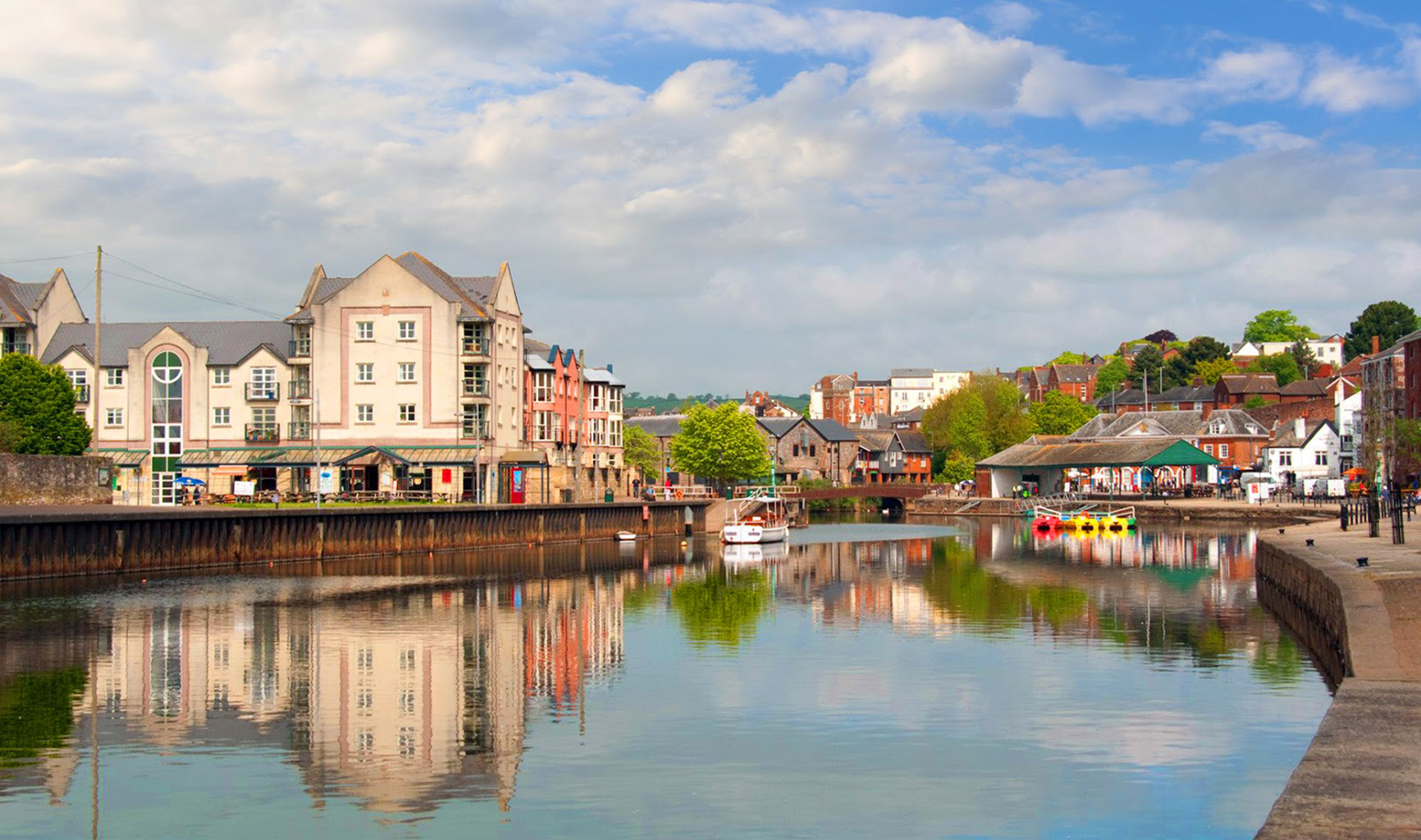
DESKTOP 3210 - EXETER, UK

Exeter is a cathedral city in Devon, England with a population of 129,800 (mid-2016 est.). It lies within the county of Devon, of which it is the county town as well as the home of Devon County Council. The administrative area has the status of a non-metropolitan district under the administration of the County Council; a plan to grant the city unitary authority status was scrapped under the 2010 coalition government. 

The city is on the River Exe about 60 km northeast of Plymouth and 110 km southwest of Bristol. Exeter was the most south-westerly Roman fortified settlement in Britain, although there is evidence a Cornish tribe existed in Exeter before the Roman invasion. Exeter became a religious centre during the Middle Ages and into the Tudor times: Exeter Cathedral, founded in the mid 11th century, became Anglican during the 16th-century English Reformation.

During the late 19th century, Exeter became an affluent centre for the wool trade, although by the First World War the city was in decline. After the Second World War, much of the city centre was rebuilt and is now considered to be a centre for modern business and tourism in Devon and Cornwall.

This post is part of the Travel Tuesday meme,
and also part of the Ruby Tuesday meme.


Tuesday, 3 May 2022

DESKTOP 3196 - GUERNSEY

Guernsey is an island in the English Channel off the coast of Normandy. With several smaller nearby islands, it forms a jurisdiction within the Bailiwick of Guernsey, a Crown dependency. The jurisdiction is made up of ten parishes on the island of Guernsey, three other inhabited islands (Herm, Jethou and Lihou), and many small islets and rocks.

The jurisdiction is not part of the United Kingdom, although defence and most foreign relations are handled by the British Government. The entire jurisdiction lies within the Common Travel Area of the British Isles and is not a member of the European Union, but has a special relationship with it, being treated as part of the European Community with access to the single market for the purposes of free trade in goods. Taken together with the separate jurisdictions of Alderney and Sark it forms the Bailiwick of Guernsey. The two Bailiwicks of Guernsey and Jersey together form the geographical grouping known as the Channel Islands.

The island of Guernsey has a population of around 63,000 in 62 km2 and forms the legal and administrative centre of the jurisdiction of Guernsey and the shopping and service centre for all three jurisdictions. The parliament of the whole jurisdiction of Guernsey, including the nearby inhabited islands of Herm, Jethou and Lihou, plus the neighbouring jurisdiction of Alderney is the States of Guernsey.

Guernsey, with its sandy beaches, cliff walks, seascapes and offshore islands has been a tourist destination since at least the Victorian days. The military history of the island has left a number of fortifications, including Castle Cornet, Fort Grey. Guernsey loophole towers and a large collection of German fortifications with a number of museums. The use of the roadstead in front of St Peter Port by over 100 cruise ships a year is bringing over 100,000 day trip passengers to the island each year.

This post is part of the Travel Tuesday meme,
and also part of the Ruby Tuesday meme.


Tuesday, 5 April 2022

DESKTOP 3168 - YORKSHIRE MOORS

The North York Moors is a national park in North Yorkshire, England, containing one of the largest expanses of heather moorland in the United Kingdom. It covers an area of 1,430 km2, and has a population of 23,380. The North York Moors became a National Park in 1952, through the National Parks and Access to the Countryside Act of 1949.

This post is part of the Travel Tuesday meme,
and also part of the Ruby Tuesday meme,
and also part of the Wordless Wednesday meme.


Tuesday, 13 July 2021

DESKTOP 2903 - LAKELAND, UK

The Lake District, also known as the Lakes or Lakeland, is a mountainous region in North West England. A popular holiday destination, it is famous for its lakes, forests and mountains (or fells) and its associations with the early 19th century writings of William Wordsworth and the other Lake Poets, Beatrix Potter and John Ruskin. Covering an area of approximately 2,362 square kilometres, the region was designated as a UNESCO World Heritage Site in 2017.

It is located entirely within the county of Cumbria, and all the land in England higher than 910 m above sea level lies within the National Park, including Scafell Pike, the highest mountain in England. It also contains the deepest and longest bodies of water in England, respectively Wast Water and Windermere.

Ashness Bridge is a traditional stone-built bridge on the single-track road from the Borrowdale road (B5289) to Watendlath, in the English Lake District. It is famous as a fine viewpoint across Borrowdale towards Skiddaw. It or its predecessor may have been a packhorse bridge conveying packhorse traffic from Watendlath to Keswick. Near the bridge is a small cairn to Bob Graham, who ran a round of 42 Lakeland peaks in 1932 (in under 24 hours), a record which was not equalled for 28 years. 

This post is part of the Our World Tuesday meme,
and also part of the Blue Monday meme,
and also part of the Travel Tuesday meme,
and also part of the Wordless Wednesday meme.


Tuesday, 10 November 2020

DESKTOP 2658 - LONDON, UK

London is the capital and most populous city of England and the United Kingdom. Standing on the River Thames in the south east of the island of Great Britain, London has been a major settlement for two millennia. It was founded by the Romans, who named it Londinium. London's ancient core, the City of London, largely retains its 1.12-square-mile (2.9 km2) medieval boundaries. Since at least the 19th century, "London" has also referred to the metropolis around this core, historically split between Middlesex, Essex, Surrey, Kent, and Hertfordshire, which today largely makes up Greater London, governed by the Mayor of London and the London Assembly.

London contains four World Heritage Sites: the Tower of London; Kew Gardens; the site comprising the Palace of Westminster (image below), Westminster Abbey, and St Margaret's Church; and the historic settlement of Greenwich (in which the Royal Observatory, Greenwich marks the Prime Meridian, 0° longitude, and GMT). Other famous landmarks include Buckingham Palace, the London Eye, Piccadilly Circus, St Paul's Cathedral, Tower Bridge, Trafalgar Square, and The Shard. London is home to numerous museums, galleries, libraries, sporting events, and other cultural institutions, including the British Museum, National Gallery, Natural History Museum, Tate Modern, British Library, and West End theatres. The London Underground is the oldest underground railway network in the world.

This post is part of the Our World Tuesday meme,
and also part of the Travel Tuesday meme,
and also part of the Wordless Wednesday meme.


Tuesday, 11 August 2020

DESKTOP 2567 - CORNWALL

Cornwall (Cornish: Kernow) is a ceremonial county and unitary authority area of England within the United Kingdom. It is bordered to the north and west by the Celtic Sea, to the south by the English Channel, and to the east by the county of Devon, over the River Tamar. Cornwall has a population of 536,000 and covers an area of 3,563 km2. The administrative centre, and only city in Cornwall, is Truro, although the town of Falmouth has the largest population for a civil parish and the conurbation of Camborne, Pool and Redruth has the highest total population. Cornwall is the homeland of the Cornish people and is recognised as one of the Celtic nations, retaining a distinct cultural identity that reflects its history.

Looe (Cornish: Logh, meaning deep water inlet) is a small coastal town, fishing port and civil parish in the former Caradon district of south-east Cornwall, UK, with a population of 5,280 at recent census (2001 & 2011 census). The two electoral wards mentioning Looe but also including Polperro had a total population of 7,117 at the 2011 census.The town of Looe is approximately 32 km west of the city of Plymouth and 11 km south of Liskeard. and is divided in two by the River Looe, East Looe and West Looe (Cornish: Porthbyhan, meaning Little Cove) being connected by a bridge. The town centres around a small harbour and along the steep-sided valley of the River Looe which flows between East and West Looe to the sea beside a sandy beach. Off shore to the west, opposite the stonier Hannafore Beach, lies the idyllic St George’s Island, otherwise known as Looe Island.

Looe’s main business today is tourism, with much of the town given over to hotels, guest houses and holiday homes, along with a large number of pubs, restaurants and beach equipment, ice cream and Cornish pasty vendors. Inland from Looe lie many camping and caravan sites, as well as the famous Woolly Monkey Sanctuary. Other local attractions include the beaches, sailing, fishing and diving, and spectacular coastal walks (especially via Talland to Polperro).

This post is part of the Our World Tuesday meme,
and also part of the Ruby Tuesday meme,
and also part of the Travel Tuesday meme,
and also part of the Wordless Wednesday meme.

Tuesday, 14 July 2020

DESKTOP 2539 - GIBRALTAR

Gibraltar is a British Overseas Territory located at the southern tip of the Iberian Peninsula. It has an area of 6.7 km2 and is bordered to the north by Spain. The landscape is dominated by the Rock of Gibraltar at the foot of which is a densely populated city area, home to over 30,000 people, primarily Gibraltarians.

In 1704, Anglo-Dutch forces captured Gibraltar from Spain during the War of the Spanish Succession on behalf of the Habsburg claim to the Spanish throne. The territory was ceded to Great Britain in perpetuity under the Treaty of Utrecht in 1713. During World War II it was an important base for the Royal Navy as it controlled the entrance and exit to the Mediterranean Sea, which is only 13 km wide at this naval "choke point". It remains strategically important to this day, with half the world's seaborne trade passing through the strait.

Today Gibraltar's economy is based largely on tourism, online gambling, financial services and cargo ship refuelling. The sovereignty of Gibraltar is a major point of contention in Anglo-Spanish relations as Spain asserts a claim to the territory. Gibraltarians overwhelmingly rejected proposals for Spanish sovereignty in the 1967 referendum, and the idea of shared sovereignty in 2002. Under the Gibraltar constitution of 2006, Gibraltar governs its own affairs, though some powers, such as defence and foreign relations, remain the responsibility of the British government.

This post is part of the Our World Tuesday meme,
and also part of the Travel Tuesday meme,
and also part of the Wordless Wednesday meme.

Tuesday, 21 April 2020

DESKTOP 2455 - MANCHESTER UK

Manchester is a city and metropolitan borough in Greater Manchester, England, with a population of 514,414 as of 2013. It lies within the United Kingdom's second-most populous urban area, with a population of 2.55 million. Manchester is fringed by the Cheshire Plain to the south, the Pennines to the north and east and an arc of towns with which it forms a continuous conurbation. The local authority is Manchester City Council.

The recorded history of Manchester began with the civilian settlement associated with the Roman fort of Mamucium or Mancunium, which was established in about AD 79 on a sandstone bluff near the confluence of the rivers Medlock and Irwell. It was historically a part of Lancashire, although areas of Cheshire south of the River Mersey were incorporated in the 20th century. Throughout the Middle Ages Manchester remained a manorial township but began to expand "at an astonishing rate" around the turn of the 19th century. Manchester's unplanned urbanisation was brought on by a boom in textile manufacture during the Industrial Revolution, and resulted in it becoming the world's first industrialised city.

Manchester achieved city status in 1853. The Manchester Ship Canal opened in 1894, creating the Port of Manchester and linking the city to sea, 36 miles (58 km) to the west. Its fortunes declined after the Second World War, owing to deindustrialisation, but the IRA bombing in 1996 led to extensive investment and regeneration. In 2014, the Globalisation and World Cities Research Network ranked Manchester as a beta world city, the highest-ranked British city apart from London. Manchester is the third-most visited city in the UK. It is notable for its architecture, culture, musical exports, media links, scientific and engineering output, social impact, sports clubs and transport connections.

The Manchester Town Hall, shown below, is a Victorian, Neo-gothic municipal building and is the ceremonial headquarters of Manchester City Council, housing a number of local government departments. The building faces Albert Square to the north, featuring the Albert Memorial and St Peter's Square to the south, home to The Cenotaph. Designed by architect Alfred Waterhouse, the town hall was completed in 1877. The building contains offices and grand ceremonial rooms such as the Great Hall which is decorated with Ford Madox Brown's imposing Manchester Murals illustrating the history of the city. The town hall, which was granted Grade I listed building status on 25 February 1952, is regarded as one of the finest interpretations of Gothic revival architecture in the world.

This post is part of the Our World Tuesday meme,
and also part of the Travel Tuesday meme,
and also part of the Wordless Wednesday meme.

Tuesday, 14 May 2019

DESLTOP 2112 - CARDIFF, UK

Cardiff (Welsh: Caerdydd) is the capital and largest city in Wales and the eleventh-largest city in the United Kingdom. The city is the country’s chief commercial centre, the base for most national cultural and sporting institutions, the Welsh national media, and the seat of the National Assembly for Wales. The unitary authority area’s mid-2011 population was estimated to be 346,100, while the population of the Larger Urban Zone was estimated at 861,400 in 2009. The Cardiff metropolitan area makes up over a third of the total population of Wales, with a mid-2011 population estimate of about 1,100,000 people.

Cardiff is a significant tourist centre and the most popular visitor destination in Wales with 18.3 million visitors in 2010. In 2011, Cardiff was ranked sixth in the world in National Geographic’s alternative tourist destinations. The city of Cardiff is the county town of the historic county of Glamorgan (and later South Glamorgan). Cardiff is part of the Eurocities network of the largest European cities. The Cardiff Urban Area covers a slightly larger area outside the county boundary, and includes the towns of Dinas Powys and Penarth.

Cardiff Castle (Welsh: Castell Caerdydd) is a medieval castle and Victorian Gothic revival mansion located in the city centre of Cardiff, Wales. The original motte and bailey castle was built in the late 11th century by Norman invaders on top of a 3rd-century Roman fort. The castle was commissioned either by William the Conqueror or by Robert Fitzhamon, and formed the heart of the medieval town of Cardiff and the Marcher Lord territory of Glamorgan.

In the 12th century the castle began to be rebuilt in stone, probably by Robert of Gloucester, with a shell keep and substantial defensive walls being erected. Further work was conducted by Richard de Clare, 6th Earl of Gloucester, in the second half of the 13th century. Cardiff Castle was repeatedly involved in the conflicts between the Anglo-Normans and the Welsh, being attacked several times in the 12th century, and stormed in 1404 during the revolt of Owain Glyndŵr.

This post is part of the Our World Tuesday meme,
and also part of the Ruby Tuesday meme,
and also part of the Travel Tuesday meme,
and also part of the Wordless Wednesday meme.

Tuesday, 6 June 2017

DESKTOP 1407 - STONEHENGE, UK

Stonehenge is a prehistoric monument in Wiltshire, England, 3 km west of Amesbury and 13 km north of Salisbury. It consists of a ring of standing stones, with each standing stone around 4.1 metres high, 2.1 metres wide and weighing around 25 tons. The stones are set within earthworks in the middle of the most dense complex of Neolithic and Bronze Age monuments in England, including several hundred burial mounds.

Archaeologists believe it was constructed from 3000 BC to 2000 BC. The surrounding circular earth bank and ditch, which constitute the earliest phase of the monument, have been dated to about 3100 BC. Radiocarbon dating suggests that the first bluestones were raised between 2400 and 2200 BC, although they may have been at the site as early as 3000 BC.

One of the most famous landmarks in the UK, Stonehenge is regarded as a British cultural icon. It has been a legally protected Scheduled Ancient Monument since 1882 when legislation to protect historic monuments was first successfully introduced in Britain. The site and its surroundings were added to UNESCO's list of World Heritage Sites in 1986. Stonehenge is owned by the Crown and managed by English Heritage; the surrounding land is owned by the National Trust.

Stonehenge could have been a burial ground from its earliest beginnings. Deposits containing human bone date from as early as 3000 BC, when the ditch and bank were first dug, and continued for at least another five hundred years.

This post is part of the Our World Tuesday meme,
and also part of the Travel Tuesday meme,
and also part of the Wordless Wednesday meme.

Tuesday, 23 May 2017

DESKTOP 1393 - WHITE CLIFFS OF DOVER

The White Cliffs of Dover are cliffs that form part of the English coastline facing the Strait of Dover and France. The cliffs are part of the North Downs formation. The cliff face, which reaches up to 110 m, owes its striking appearance to its composition of chalk accented by streaks of black flint. The cliffs stretch along the coastline for 13 km, spreading east and west from the town of Dover in the county of Kent, an ancient and still important English port.

The cliffs have great symbolic value in Britain because they face towards continental Europe across the narrowest part of the English Channel, where invasions have historically threatened and against which the cliffs form a symbolic guard. The National Trust calls the cliffs "an icon of Britain", with "the white chalk face a symbol of home and war time defence." Because crossing at Dover was the primary route to the continent before the advent of air travel, the white line of cliffs also formed the first or last sight of Britain for travellers. In World War II, thousands of allied troops on the little ships in the Dunkirk evacuation saw the welcoming sight of the cliffs.

This post is part of the  Our World Tuesday meme,
and also part of the Travel Tuesday meme,
and also part of the Wordless Wednesday meme.

And one cannot forget the classic Vera Lynn song in this context:

Sunday, 30 April 2017

DESKTOP 1370 - WHITBY ABBEY

Whitby Abbey is a ruined Benedictine abbey overlooking the North Sea on the East Cliff above Whitby in North Yorkshire, England. It was disestablished during the Dissolution of the Monasteries under the auspices of Henry VIII. It is a Grade I Listed building in the care of English Heritage and its site museum is housed in Cholmley House.

This post is part of the My Sunday Best meme,

and also part of the My Sunday Photo meme,
and also part of the Photo Sunday meme, 
and also part of the inSPIREd Sunday meme.

Wednesday, 15 March 2017

DESKTOP 1324 - JERSEY

Jersey (officially the Bailiwick of Jersey), is a Crown dependency of the United Kingdom, ruled by the Crown in right of Jersey, off the coast of Normandy, France. Jersey was part of the Duchy of Normandy, whose dukes went on to become kings of England from 1066. After Normandy was lost by the kings of England in the 13th century, and the ducal title surrendered to France, Jersey and the other Channel Islands remained attached to the English crown. Jersey is a self-governing parliamentary democracy under a constitutional monarchy, with its own financial, legal and judicial systems, and the power of self-determination.

The Lieutenant Governor on the island is the personal representative of the Queen. British cultural influence on the island can also be seen with the main language being English, British pound currency, driving on the left, BBC and ITV regions, school curriculum following that of England, and the popularity of British sports, including football, cricket and rugby. The bailiwick consists of the island of Jersey, along with surrounding uninhabited islands and rocks collectively named Les Dirouilles, Les Écréhous, Les Minquiers, Les Pierres de Lecq, and other reefs. The island of Jersey is the largest of the Channel Islands.

This post is part of the Outdoor Wednesday meme,
and also part of the Wordless Wednesday meme,
and also part of the ABC Wednesday meme,
and also part of the Wednesday Waters meme,
and also part of the Travel Tuesday meme.


Tuesday, 28 February 2017

MY DESKTOP 1309 - NORTH YORK MOORS

The North York Moors is a national park in North Yorkshire, England, containing one of the largest expanses of heather moorland in the United Kingdom. It covers an area of 1,430 km2, and has a population of 23,380. The North York Moors became a National Park in 1952, through the National Parks and Access to the Countryside Act of 1949.

This post is part of the Our World Tuesday meme,
and also part of the Travel Tuesday meme,
and also part of the Wordless Wednesday meme.