Showing posts with label Western_Australia. Show all posts

Tuesday, 4 January 2022

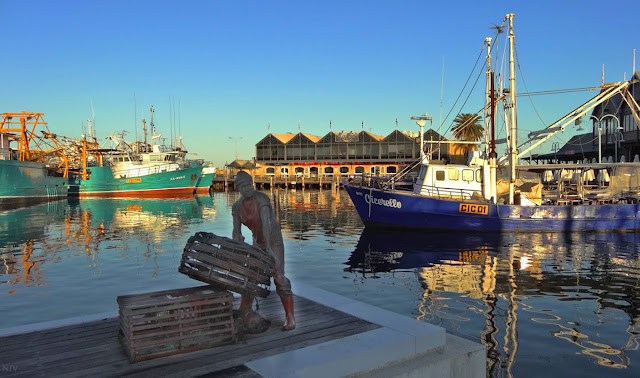
DESKTOP 3078 - FREMANTLE

Fremantle Fishing Boat Harbour is a commercial marina in Fremantle, Western Australia, adjacent to the more recently constructed Challenger Harbour. It provides large sheltered mooring areas, wharf space for vessels up to 60 metres, refuelling facilities and support services to the Fremantle fishing industry. The harbour was built in 1919 when a 300-metre breakwater was constructed to provide an anchorage for fishing vessels. South Jetty was immediately adjacent and included a fish market which was removed in 1929.

A southern breakwater was constructed in 1962 and land reclaimed to house fishing companies and service industries. Between 1969 and 1972, up to 120 fishing boats were housed in the harbour and in 1982, construction of a boat lifting facility commenced. Fremantle Fishing Boat Harbour is now surrounded by a well established tourism precinct, and over a dozen restaurants and a brewery are immediately adjacent.

This post is part of the Our World Tuesday meme,
and also part of the Ruby Tuesday meme,
and also part of the Travel Tuesday meme,
and also part of the Wordless Wednesday meme.

Thursday, 23 September 2021

DESKTOP 2975 - AUSTRALIAN FLAME PEA

Chorizema cordatum, known as the heart-leaf flame pea or Australian flame pea, is a flowering plant of the Fabaceae (pea family), endemic to gravelly or loamy soils in eucalyptus forests, in the moist south western parts of Western Australia. It is a bushy, evergreen shrub.
 
The attractive and noticeable flowers appear in late winter or spring in long racemes. Either starting at the end of stems or from the leaf axils. Flowers are orange and red, 10 to 12 mm in diameter. The heart shaped (or narrower) leaves are 3 to 5 cm long with somewhat wavy edges.
 
It can be grown as a garden plant, and does well in other parts of the country, (such as Sydney on the other side of the Australian continent). However, a summer with lower humidity is better suited for this plant. Propagation from seed is easily achieved, and cuttings strike well. This plant has gained the Royal Horticultural Society's Award of Garden Merit.
 
This post is part of the Floral Friday Fotos meme,


Thursday, 16 September 2021

DESKTOP 2968 - PAPER DAISIES

Rhodanthe, also known as sunray or pink paper daisy, is a genus of Australian plants in the pussy's-toes tribe within the daisy family, Asteraceae. The name Rhodanthe is derived from Greek rhodon, rose and anthos, flower. Many Rhodanthe species were formerly classed under different genera, including Helipterum, Podotheca, Acroclinium and Waitzia.
 
Rhodanthe chlorocephala subspecies rosea (shown here) is the most widely grown subspecies and is commonly known as “Pink and White Everlasting”, “Rosy Sunray”, “Pink Paper-daisy” and “Rosy Everlasting”. It grows naturally in the south of Western Australia extending into South Australia. Rhodanthe chlorocephala subsp. rosea is an erect annual herb 20-60cm high with clumps of glabrous (hairless) grey-green stems and leaves 1-6cm in length. It has a large single flowering head at the tip of each stem. Flower heads grow to 6cm diameter, gradually decreasing as the flowering season progresses. The colour of the bracts varies from deep pink (almost red) through pale pink to pure white, with a yellow or black centre. Stems branch early in the season. You can encourage this habit (to create more blossoms) by pinching out the growing tips.
 
Rhodanthe chlorocephala subsp. rosea is adaptable and ephemeral, springing up whenever conditions are right e.g. during warm, sunny weeks anytime of the year. It prefers full sun to dappled shade and grows well in open woodland. Grown in full shade it tends to be long and spindly. It thrives in well-drained sandy soils and tends to be smaller when grown in heavy, clay soils. It generally flowers from August to November in the wild but with sufficient water and warmth it will flower at other times. It flowers 10 to 12 weeks after germination and the flowers last a good two weeks. The flowering period lasts 4 to 10 weeks. Fruit appear approximately 4 weeks after flowering.

This post is part of the Floral Friday Fotos meme

Tuesday, 24 August 2021

DESKTOP 2945 - PERTH GOVERNMENT HOUSE

Government House in Perth, the state capital of Western Australia, is the official residence of the Governor of Western Australia and was built between 1859 and 1864. The buildings and gardens are of exceptional heritage significance, being listed on the Western Australian Register of Heritage Places, classified by the National Trust of Australia (W.A.) and entered on the Register of the National Estate. The gardens are often open to the public, as is the House from time to time.
 
The building is a two storey mansion in the early Stuart or Jacobean Revival style set on 32,000 square metres of English gardens in the centre of the Perth business district, between St. Georges Terrace and the Swan River. The unique architectural character of the building is characterised by the use of stonework and bonded brickwork, incorporating square mullioned windows, decorated gables and ogival capped turrets. The attenuated gothic arcading at ground floor level derives from another form of Victorian Revival expression Fonthill Gothic.
 
The building has 16 rooms on the ground floor and 25 on the first floor. According to the Western Australian Register of Heritage Places Assessment, Government House is a 'unique example of a Victorian Gentleman's residence' set in landscaped gardens with mature plantings and a number of commemorative trees.

This post is part of the Our World Tuesday meme,
and also part of the Ruby Tuesday meme,
and also part of the Travel Tuesday meme,
and also part of the Wordless Wednesday meme.


Thursday, 17 June 2021

DESKTOP 2877 - ROSE CONE FLOWER

Isopogon formosus, or Rose Cone Flower, in the Proteaceae family is a shrub that is endemic to areas near Albany and Esperance in Western Australia. It occurs naturally in heathland and woodland areas. It has an erect or bushy form and is usually between 1.5 and 2 metres high. The pink flowers appear from mid winter to early summer. Rounded "drumsticks" containing the seeds appear later, formed from the old flower parts.
 
The plant's leaves are divided, narrow, terete and about 5 cm long. It was first described by Robert Brown in 1810. In 1891, German botanist Otto Kuntze published Revisio generum plantarum, his response to what he perceived as a lack of method in existing nomenclatural practice. Because Isopogon was based on Isopogon anemonifolius, and that species had already been placed by Richard Salisbury in the segregate genus Atylus in 1807, Kuntze revived the latter genus on the grounds of priority, and made the new combination Atylus formosus for this species. However, Kuntze's revisionary program was not accepted by the majority of botanists. Ultimately, the genus Isopogon was nomenclaturally conserved over Atylus by the International Botanical Congress of 1905.
 
Isopogon formosus requires excellent drainage and full sun. It will not tolerate long periods of dryness or heavy frost. It is usually propagated from seed which germinates readily without pre-treatment. Cuttings are also successful using firm, current season's growth. Some limited work has been carried out by enthusiasts on the grafting of western species of Isopogon, onto eastern rootstock to extend the range where the plants can be grown. This offers the best chance for successful cultivation in humid areas.

This post is part of the Floral Friday Fotos meme


Thursday, 12 November 2020

DESKTOP 2660 - SHOWY EVERLASTING DAISY

Showy Everlasting Daisy, Schoenia filifolia ssp. subulifolia, (synonym Helichrysum subulifolium) is a native Western Australian daisy now threatened with extinction in the wild. Fortunately, this species responds well to cultivation and is being planted widely in parks, gardens and forested areas throughout Australia. It has many fine, bright green leaves and many upright stems to between 30 and 40 cm high. Each stem carries a large golden-yellow flower that is 2 to 4 cm across. The flowers are good for drying, to use in dried flower arrangements.

This post is part of the Floral Friday Fotos meme.


Tuesday, 28 July 2020

DESKTOP 2553 - FREMANTLE

Fremantle is a city in Western Australia, located at the mouth of the Swan River. Fremantle Harbour serves as the port of Perth, the state capital. Fremantle was the first area settled by the Swan River colonists in 1829. It was declared a city in 1929, and has a population of approximately 25,000. The city is named after Captain Charles Howe Fremantle, the English naval officer who had pronounced possession of Western Australia and who established a camp at the site. The city contains well-preserved 19th-century buildings and other heritage features. The Western Australian vernacular diminutive for Fremantle is Freo.

This post is part of the Our World Tuesday meme,
and also part of the Ruby Tuesday meme,
and also part of the Travel Tuesday meme,
and also part of the Wordless Wednesday meme.

Tuesday, 21 July 2020

DESKTOP 2546 - SWAN RIVER, PERTH

By the banks of the majestic Swan River in Perth, Australia. A winter's day.

This post is part of the Our World Tuesday meme,
and also part of the Travel Tuesday meme.

Friday, 21 February 2020

DESKTOP 2395 - FREMANTLE

Fremantle is a city in Western Australia, located at the mouth of the Swan River. Fremantle Harbour serves as the port of Perth, the state capital. Fremantle was the first area settled by the Swan River colonists in 1829. It was declared a city in 1929, and has a population of approximately 25,000. The city is named after Captain Charles Howe Fremantle, the English naval officer who had pronounced possession of Western Australia and who established a camp at the site. The city contains well-preserved 19th-century buildings and other heritage features. The Western Australian vernacular diminutive for Fremantle is Freo.

This post is part of the Skywatch Friday meme.

Tuesday, 17 December 2019

DESKTOP 2329 - BROOME, AUSTRALIA

Broome is a coastal, pearlfishing and tourist town in the Kimberley region of Western Australia, 2,240 km north of Perth. The urban population is estimated at 14,776, growing to over 45,000 per month during the tourist season. Broome International Airport provides transport to several domestic destinations.

Cable Beach is situated 7 km from town along a bitumen road and is named in honour of the Java-to-Australia undersea telegraph cable which reaches shore there. The beach itself is 22.5 km long with white sand, washed by tides that can reach over 9 m. The beach is almost perfectly flat. Caution is required when swimming from November to March as box jellyfish are present during those months. There have been cases where crocodiles have been sighted off the shore, but this is a rarity and measures are taken to prevent these situations.

Four wheel drive vehicles may be driven onto the beach from the car park. This allows people to explore the beach at low tide to a much greater extent than would be possible on foot. Sunset camel rides operate daily along the beach.

This post is part of the Our World Tuesday meme,
and also part of the Blue Monday meme,
and also part of the Travel Tuesday meme,
and also part of the Wordless Wednesday meme.

Monday, 2 December 2019

DESKTOP 2315 - PINNACLES, WA

The Pinnacles are limestone formations contained within Nambung National Park, near the town of Cervantes, Western Australia. The raw material for the limestone of the Pinnacles came from seashells in an earlier epoch rich in marine life. These shells were broken down into lime rich sands which were blown inland to form high mobile dunes. The Pinnacles remained unknown to most Australians until the 1960s, when the area was added to Nambung National Park. The area receives over 250,000 visitors a year. A visitor precinct and interpretive centre was completed in March 2008.

The best season to see the Pinnacles is Spring (from August to October), as the days are mild and wildflowers start to bloom. The pinnacle formations are best viewed in the early morning or late afternoon as the play of light brings out the colours and the extended shadows of the formations delivers a contrast that brings out their features. Most animals in the park are nocturnal, but emus and kangaroos can be seen during the daytime, more commonly in the evening or early morning.

This post is part of the Our World Tuesday meme,
and also part of the Travel Tuesday meme,
and also part of the Wordless Wednesday meme.

Tuesday, 29 October 2019

MY DESKTOP 2279 - ESPERANCE, WESTERN AUSTRALIA

Esperance is a town in the Goldfields-Esperance region of Western Australia, on the Southern Ocean coastline approximately 720 kilometres east-southeast of the state capital, Perth. The urban population of Esperance was over 10,000 as at the 2016 Census. Its major industries are tourism, agriculture, and fishing. The Shire of Esperance is home to 13,477 people.

Near the town itself are numerous beaches, offering surfing, scuba diving, and swimming. Also nearby are a number of salt lakes, including Pink Lake, which gains its rosy hue from red algae living within its waters. Esperance is also home to the Cyclops wave, said to be the world's heaviest wave with massive amounts of water unloading on shallow reef. Cyclops is featured in the surfing films Billabong Odyssey, and the Bra Boys documentary.

There are five major national parks near the town. A major nearby tourist attraction, 20 minutes away from the town centre, is the Cape Le Grand National Park, which offers a picturesque coast of largely granite terrain and sheltered white sand beaches. The park is a popular spot for recreational fishing, as well as four wheel drive enthusiasts and hikers.Esperance also has a number of wind turbines supplying electricity to the town. Esperance had the first electrical wind farm in Australia, built at Salmon Beach as a research facility in 1987.

This post is part of the Our World Tuesday meme,
and also part of the Travel Tuesday meme,
and also part of the Wordless Wednesday meme.

Tuesday, 21 May 2019

DESKTOP 2119 - PERTH, AUSTRALIA

Perth is the capital and largest city of the Australian state of Western Australia. It is the fourth most populous city in Australia, with an estimated population of 1.74 million living in the Perth metropolitan area. The metropolitan area is located in the South West Division of Western Australia, between the Indian Ocean and a low coastal escarpment known as the Darling Range. The central business district and suburbs of Perth are situated on the banks of the Swan River.

Shortly after the establishment of the port settlement of Fremantle, Perth was founded on 12 June 1829 by Captain James Stirling as the political centre of the Swan River Colony. As the business and administration centre for the resource-rich state, Perth has grown consistently.  Perth became known worldwide as the “City of Light” when city residents lit their house lights and streetlights as American astronaut John Glenn passed overhead while orbiting the earth on Friendship 7 in 1962. The city repeated the act as Glenn passed overhead on the Space Shuttle in 1998. Perth is tied for eighth place in The Economist’s 2011 list of the world's most livable cities.

Perth’s residents have traditionally enjoyed the highest standard of living of any of Australia’s big cities.  Until recently, the reason for this has been that, for most occupations, wages were only a little less than could be found in cities such as Sydney and Melbourne while house prices in Perth were considerably lower than the other cities.

This post is part of the Our World Tuesday meme,
and also part of the Travel Tuesday meme,
and also part of the  Wordless Wednesday meme.

Monday, 6 May 2019

DESKTOP 2105 - FREMANTLE, WA

Fremantle is a city in Western Australia, located at the mouth of the Swan River. Fremantle Harbour serves as the port of Perth, the state capital. Fremantle was the first area settled by the Swan River colonists in 1829. It was declared a city in 1929, and has a population of approximately 25,000. The city is named after Captain Charles Howe Fremantle, the English naval officer who had pronounced possession of Western Australia and who established a camp at the site. The city contains well-preserved 19th-century buildings and other heritage features. The Western Australian vernacular diminutive for Fremantle is Freo.

The native Australian Noongar people inhabited the area that is now Fremantle, which was known as Walyalup. The area was considered as a site for possible British settlement in 1827, when Captain James Stirling, in HMS Success, explored the coastal areas near the Swan River. As a result of Stirling's report, Captain Charles Howe Fremantle of HMS Challenger, a 603 ton, 28-gun frigate, was instructed to sail to the west coast of Australia to establish a settlement there. On 2 May 1829, Fremantle hoisted the Union Flag in a bay near what is now known as Arthur Head, and in accordance with his instructions, took formal possession “of the whole of the West Coast of New Holland” in the name of George IV of the United Kingdom.

Shown here is the fishing boat harbour, which as well as being a working harbour has numerous, cafés, restaurants, tourist shops and a micro-brewery.

This post is part of the Our World Tuesday meme,
and also part of the Ruby Tuesday meme,
and also part of the Travel Tuesday meme,
and also part of the Wordless Wednesday meme.

Wednesday, 1 May 2019

DESKTOP 2099 - QUOKKA

The quokka (Setonix brachyurus), the only member of the genus Setonix, is a small macropod about the size of a domestic cat. Like other marsupials in the macropod family (such as kangaroos and wallabies), the quokka is herbivorous and mainly nocturnal.

Quokkas can be found on some smaller islands off the coast of Western Australia, in particular on Rottnest Island just off Perth and Bald Island near Albany. A small mainland colony exists in the protected area of Two Peoples Bay Nature Reserve, where they co-exist with the critically endangered Gilbert's potoroo.

This post is part of the Wordless Wednesday meme,
and also part of the ABC Wednesday meme,
and also part of the Nature Notes meme.

Thursday, 28 February 2019

DESKTOP 2037 - CORAL VINE

Kennedia coccinea (Coral Vine) is a species of flowering plant in the family Fabaceae, endemic to the south-west of Western Australia. It is a low growing trailing shrub or climber which has twining rust-coloured branchlets with rounded leaflets that are about 1.5 cm long and occur in threes. Orange red or scarlet pea flowers are produced in clusters between August and November in its native range. The species was first formally described by E.P. Ventenat in 1804 in Jardin de la Malmaison.

Two varieties were described in Paxton's Magazine of Botany in 1835, namely var. elegans and var. coccinea. Three further varieties were transferred from the genus Zichya in 1923 by Domin, namely var. molly , var.  sericea and var. villosa. Currently, the Western Australian Herbarium recognises only two informal subspecies known tentatively as subsp. Coastal and subsp. Inland. The species is naturally adapted to sandy or lighter soils and prefers some shade. It is resistant to drought and has some frost tolerance. Plants can be propagated by scarified seed or cuttings of semi-mature growth.

 This post is part of the Floral Friday Fotos meme.

Thursday, 21 February 2019

DESKTOP 2030 - SWAN RIVER DAISY

Brachyscome iberidifolia (Swan River Daisy) is a delightful, easy to grow small shrub 15cm to 45cm and is native to Western and central Australia. Masses of purple, blue or white flowers from Spring to Autumn. Ideal for mass planting along borders, rockeries, as ground cover, in tubs or hanging baskets.

Brachyscome is a genus of around 70 species of mostly annual and perennial herbs and a few subshrubs in the daisy family Asteraceae. 65 of these are endemic to Australia, the remainder being found in New Zealand and New Guinea. They have typical "daisy" flower heads with showy ray florets in shades of white, pink, mauve, violet or blue, surrounding a usually narrow group of yellow disk florets. The leaves are often dissected to varying degrees but may be linear or spathulate. In growth habit they vary between plants with a rosette of basal leaves and more-or-less leafless flower scape, and those with mostly cauline leaves and often prostrate stems.

This post is part of the Floral Friday Fotos meme.

Sunday, 20 January 2019

DESKTOP 1998 - PERTH, WESTERN AUSTRALIA

Situated beside the Swan River, Perth the capital of Western Australia is a living picture postcard, as this view of the city from an airplane shows. Regular flights to Perth depart from overseas, all state capitals and many regional locations, landing you just 20 minutes from the central business district. Perth offers an eclectic mix of city culture and stunning nature, from Perth’s burgeoning bar scene and open arts festivals, to its world-class beaches and expansive parklands. Australia’s sunniest capital city, Perth embraces a relaxed outdoor lifestyle. Whether in the 400 hectares of Kings Park in the city or the inviting clear waters and spectacular sunsets at Cottesloe Beach, Perth is sure to please every visitor.

This post is part of the My Sunday Best meme.

Tuesday, 20 November 2018

DESKTOP 1937 - FREMANTLE BEACH

Fremantle is a city in Western Australia, located at the mouth of the Swan River. Fremantle Harbour serves as the port of Perth, the state capital. Fremantle was the first area settled by the Swan River colonists in 1829. It was declared a city in 1929, and has a population of approximately 25,000. The city is named after Captain Charles Howe Fremantle, the English naval officer who had pronounced possession of Western Australia and who established a camp at the site. The city contains well-preserved 19th-century buildings and other heritage features. The Western Australian vernacular diminutive for Fremantle is Freo.

This post is part of the Our World Tuesday meme,
and also part of the Ruby Tuesday meme,
and also part of the Travel Tuesday meme,
and also part of the Wordless Wednesday meme.

Tuesday, 13 November 2018

DESKTOP 1930 - BEACH, WESTERN AUSTRALIA

Observatory Beach is situated in the beautiful views in the coastline of Cape Le Grand National Park in Esperance, Western Australia. The beach has a prime location especially for those looking to enjoy a beach-side location. The distance is 5 min. stroll into town. You can examine the memorial placed at the viewpoint remembering the explorers named French Frigates, the L’esperance and the Recherche who took shelter from the storm in 1792. You can have the view of the remarkable sight of whales that can frequently be seen swimming through the surrounding ocean between the months of June and October.

This post is part of the Our World Tuesday meme,
and also part of the Travel Tuesday meme,
and also part of the Wordless Wednesday meme.