Showing posts with label statue. Show all posts

Tuesday, 30 August 2022

DESKTOP 3313 - VALENCIA, SPAIN

Valencia on the east coast of Spain, is the capital of the autonomous community of Valencia and the third-largest city in Spain after Madrid and Barcelona, with around 800,000 inhabitants in the administrative centre. Its urban area extends beyond the administrative city limits with a population of around 1.5–1.6 million people.

The Port of Valencia is the 5th busiest container port in Europe and the busiest container port on the Mediterranean Sea. The city is ranked at Gamma+ in the Globalization and World Cities Research Network. Valencia is integrated into an industrial area on the Costa del Azahar (Orange Blossom Coast).

This post is part of the Travel Tuesday meme


Sunday, 17 April 2022

DESKTOP 3180 - ZEN

A corner of our garden where a meditating Buddha encourages us to be calm and relaxed, taking city life in our stride. Zen (also Zen Buddhism) noun [mass noun] is a Japanese school of Mahayana Buddhism emphasising the value of meditation and intuition rather than ritual worship or study of scriptures.
 
Zen Buddhism was introduced to Japan from China in the 12th century, and has had a profound cultural influence. The aim of Zen is to achieve sudden enlightenment (satori) through meditation in a seated posture (zazen), usually under the guidance of a teacher and often using paradoxical statements (koans) to transcend rational thought.
 
ORIGIN Japanese, literally ‘meditation’, from Chinese chán ‘quietude’, from Sanskrit dhyāna ‘meditation’.

This post is part of the My Sunday Best meme


Sunday, 3 April 2022

DESKTOP 3166 - VICTORIANA

Many a Melbourne house in the inner city is original Victorian, complete with ironwork lace balconies and sculptural architectural decorations.

This post is part of the My Sunday Best meme.


Tuesday, 15 February 2022

DESKTOP 3119 - COPENHAGEN, DENMARK

The Little Mermaid (Danish: Den lille Havfrue) is a bronze statue by Edvard Eriksen, depicting a mermaid. The sculpture is displayed on a rock by the waterside at the Langelinie promenade in Copenhagen, Denmark. It is 1.25 metres tall and weighs 175 kilograms. Based on the fairy tale of the same name by Danish author Hans Christian Andersen, the small and unimposing statue is a Copenhagen icon and has been a major tourist attraction since 1913.
 
In recent decades it has become a popular target for defacement by vandals and political activists. The Little Mermaid is among iconic statues that symbolise cities; others include: Manneken Pis in Brussels, the Statue of Liberty in New York and Christ the Redeemer in Rio de Janeiro. In several cases, cities have commissioned statues for such a purpose, such as with Singapore's Merlion.

This post is part of the Our World Tuesday meme,
and also part of the Travel Tuesday meme,
and also part of the Wordless Wednesday meme.


Tuesday, 4 January 2022

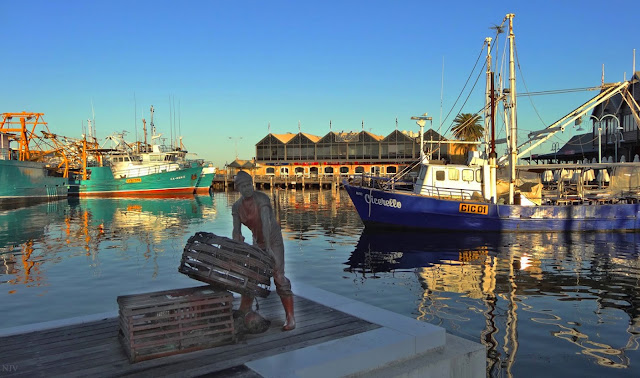
DESKTOP 3078 - FREMANTLE

Fremantle Fishing Boat Harbour is a commercial marina in Fremantle, Western Australia, adjacent to the more recently constructed Challenger Harbour. It provides large sheltered mooring areas, wharf space for vessels up to 60 metres, refuelling facilities and support services to the Fremantle fishing industry. The harbour was built in 1919 when a 300-metre breakwater was constructed to provide an anchorage for fishing vessels. South Jetty was immediately adjacent and included a fish market which was removed in 1929.

A southern breakwater was constructed in 1962 and land reclaimed to house fishing companies and service industries. Between 1969 and 1972, up to 120 fishing boats were housed in the harbour and in 1982, construction of a boat lifting facility commenced. Fremantle Fishing Boat Harbour is now surrounded by a well established tourism precinct, and over a dozen restaurants and a brewery are immediately adjacent.

This post is part of the Our World Tuesday meme,
and also part of the Ruby Tuesday meme,
and also part of the Travel Tuesday meme,
and also part of the Wordless Wednesday meme.


Tuesday, 9 February 2021

DESKTOP 2749 - DION, GREECE

Dion or Dio (Ancient Greek: Δίον, Greek: Δίο, Latin: Dium) is a village and a former municipality in the Pieria regional unit, Greece. Since the 2011 local government reform, it is part of the municipality Dio-Olympos, of which it is a municipal unit. It is located at the foot of Mount Olympus. It is best known for its great ancient Macedonian sanctuary of Zeus and city, much of which is visible in the Archaeological Park of Dion and the Archaeological Museum of Dion.
 
The ancient city owes its name to the most important Macedonian sanctuary dedicated to Zeus (Dios, "of Zeus"), leader of the gods who dwelt on Mount Olympus; as recorded by Hesiod's "Catalogue of Women", Thyia, daughter of Deucalion, bore Zeus two sons, Magnes and Makednos, eponyms of Magnetes and Macedonians, who dwelt in Pieria at the foot of Mount Olympus.
 
Hence from very ancient times, a large altar had been set up for the worship of Olympian Zeus and his daughters, the Muses, in a unique environment characterised by rich vegetation, towering trees, countless springs and a navigable river. For this reason Dion was the "sacred place" of the Ancient Macedonians. It was the place where the kings made splendid sacrifices to celebrate the new year of the Macedonian calendar at the end of September. In the Spring, purification rites of the army and victory feasts were held.
 
A city was built adjacent to the sacred sites that acquired monumental form during the reigns of Alexander the Great's successors and Cassander took a great interest in the city erecting strong walls and public buildings, so that in Hellenistic times Dion was renowned far and wide for its fortification and splendid monuments. Dion and its sanctuary was destroyed in 219 BC by Aetolian invaders but was immediately rebuilt by Philip V. Many of the dedications from the sanctuary that had been destroyed were buried in pits, including royal inscriptions and treaties, and these have been discovered recently.

This post is part of the Our World Tuesday meme,
and also part of the Travel Tuesday meme,
and also part of the Wordless Wednesday meme.


Sunday, 12 April 2020

DESKTOP 2446 - RIO

Rio de Janeiro (‘River of January’), or simply Rio, is the second-most populous municipality in Brazil and the sixth-most populous in the Americas. Rio de Janeiro is the capital of the state of Rio de Janeiro, Brazil’s third-most populous state. Part of the city has been designated as a World Heritage Site, named “Rio de Janeiro: Carioca Landscapes between the Mountain and the Sea”, by UNESCO on 1 July 2012 as a Cultural Landscape. Founded in 1565 by the Portuguese, the city was initially the seat of the Captaincy of Rio de Janeiro, a domain of the Portuguese Empire. Later, in 1763, it became the capital of the State of Brazil, a state of the Portuguese Empire.

This post is part of the My Sunday Best meme,

Tuesday, 21 January 2020

DESKTOP 2364 - RIO

Rio de Janeiro (‘River of January’), or simply Rio, is the second-most populous municipality in Brazil and the sixth-most populous in the Americas. Rio de Janeiro is the capital of the state of Rio de Janeiro, Brazil’s third-most populous state. Part of the city has been designated as a World Heritage Site, named “Rio de Janeiro: Carioca Landscapes between the Mountain and the Sea”, by UNESCO on 1 July 2012 as a Cultural Landscape. Founded in 1565 by the Portuguese, the city was initially the seat of the Captaincy of Rio de Janeiro, a domain of the Portuguese Empire. Later, in 1763, it became the capital of the State of Brazil, a state of the Portuguese Empire.

This post is part of the Our World Tuesday meme,
and also part of the Travel Tuesday meme,
and also part of the Wordless Wednesday meme.

Wednesday, 19 June 2019

DESKTOP 2148 - XOANON

Xoanon | ˈzəʊənɒn | noun (plural xoana | ˈzəʊənə | )
(in ancient Greece) a primitive wooden image of a deity.
ORIGINEarly 18th century: from Greek; related to xein ‘carve’.


Totem poles of painted, carved wood in Vancouver, Canada, created by Indigenous peoples of the Northwest Coast of North America. They variously portray family legends and lineage, spirituality, sacred or mythological beings, and culturally important animals, people or events.

This post is part of the Wordless Wednesday meme,
and also part of the ABC Wednesday meme.

Monday, 19 November 2018

DESKTOP 1936 - SEASONS

This post is part of the Mosaic Monday meme,
and also part of the Blue Monday meme,
and also part of the Through my Lens meme,
and also part of the Seasons meme.
19th century French gilt statuettes of the Four Seasons.

Wednesday, 20 June 2018

DESKTOP 1785 - XERXES

Xerxes I (Old Persian: 𐎧𐏁𐎹𐎠𐎼𐏁𐎠 x-š-y-a-r-š-a Xšayaṛša "ruling over heroes", Greek Ξέρξης [ksérksɛːs]; 519–465 BC), called Xerxes the Great, was the fourth king of kings of the Achaemenid dynasty of Persia. Like his predecessor Darius I, he ruled the empire at its territorial apex. He ruled from 486 BC until his assassination in 465 BC at the hands of Artabanus, the commander of the royal bodyguard.

Xerxes I is one of the Persian kings identified as Ahasuerus in the biblical Book of Esther. He is also notable in Western history for his failed invasion of Greece in 480 BC. His forces temporarily overran mainland Greece north of the Isthmus of Corinth until the losses at Salamis and Plataea a year later reversed these gains and ended the second invasion decisively. Xerxes also crushed revolts in Egypt and Babylon. Roman Ghirshman says that, "After this he ceased to use the title of 'king of Babylon', calling himself simply 'king of the Persians and the Medes'." Xerxes oversaw the completion of various construction projects at Susa and Persepolis.

The bas-relief below from Persepolis shows Darius I, the Great who is seated. He is followed by his son, the Crown Prince, Xerxes. Xerxes is depicted in the same size and with his head at the same level as his father's. This indicates not only that Xerxes was the heir apparent, but also co-ruler with his father, Darius. Immediately behind Xerxes is Nehemiah; here seen as the Chief Cupbearer, a position of highest rank with a function similar to that of "Prime Minister." The kings are receiving tribute.

This post is part of the Wordless Wednesday meme,
and also part of the ABC Wednesday meme.

Sunday, 1 April 2018

DESKTOP 1706 - ST FRANCIS' CHURCH

St Francis' Church is the oldest Catholic church in Victoria, Australia. Located on the corner of Lonsdale Street and Elizabeth Street, it is one of only three buildings in central Melbourne which predates the Gold Rush of 1851. The church's foundation stone was laid on 4 October 1841, the feast day of St Francis of Assisi, to whom the church is dedicated.

It was commissioned by Fr Patrick Geoghegan, the first Catholic priest in the Port Phillip District of New South Wales, which became Victoria in 1851. In 1848, St Francis' became the cathedral church of the first Catholic Bishop of Melbourne, James Goold, and continued as a cathedral until 1868, when the diocesan seat was moved to the still unfinished St Patrick's Cathedral (which was not formally consecrated until 1897).

This post is part of the My Sunday Best meme,
and also part of the My Sunday Photo meme,
and also part of the Photo Sunday meme,
and also part of the inSPIREd Sunday meme.

Sunday, 13 August 2017

DESKTOP 1475 - MANEKI-NEKO

The maneki-neko (Japanese: 招き猫, literally "beckoning cat") is a common Japanese figurine (lucky charm, talisman) which is often believed to bring good luck to the owner. In modern times, they are usually made of ceramic or plastic. The figurine depicts a cat (traditionally a calico Japanese Bobtail) beckoning with an upright paw, and is usually displayed in—often at the entrance of—shops, restaurants, pachinko parlours, and other businesses. Some of the sculptures are electric or battery-powered and have a slow-moving paw beckoning.

Maneki-neko comes in different colours, styles and degrees of ornateness. Common colours are white, black, gold and sometimes red. In addition to ceramic figurines, maneki-neko can be found as keychains, piggy banks, air fresheners, house-plant pots, and miscellaneous ornaments, as well as large statues. It is also sometimes called the "Chinese lucky cat" due to its popularity among Chinese merchants.

To some Westerners (Italians and Spaniards are notable exceptions) it may seem as if the maneki-neko is waving rather than beckoning. This is due to the difference in gestures and body language recognised by some Westerners and the Japanese. The Japanese beckoning gesture is made by holding up the hand, palm down, and repeatedly folding the fingers down and back, thus the cat's appearance. Some maneki-neko made specifically for some Western markets will have the cat's paw facing upwards, in a beckoning gesture that is more familiar to most Westerners.

Maneki-neko can be found with either the right or left paw raised (and sometimes both). The significance of the right and left raised paw differs with time and place. Some say that a left paw raised is best for drinking establishments, the right paw for other stores; another interpretation is that right is for home and left for business.

This post is part of the My Sunday Best meme,
and also part of the My Sunday Photo meme,
and also part of the Photo Sunday meme.