Showing posts with label lilac. Show all posts

Wednesday, 27 July 2022

DESKTOP 3279 - GOATSBEARD

Tragopogon, also known as goatsbeard or salsify, is a genus of flowering plants in the Asteraceae (sunflower) family. It includes the vegetable known as salsify, as well as a number of common wild flowers, some of which are usually regarded as weeds. Salsifies are forbs growing as biennial or perennial plants. They have a strong taproot and milky sap. They generally have few branches, and those there are tend to be upright. Their leaves are somewhat grass-like.

This post is part of the Wordless Wednesday meme,
and also part of the My Corner of the World meme,
and also part of the Nature Notes meme.

Thursday, 13 January 2022

DESKTOP 3087 - MINT BUSH

Prostanthera, commonly known as mintbush or mint bush, is a genus of flowering plants of the family Lamiaceae. There are about 90 species within the genus, all of which are endemic to Australia. The word is derived from the Greek for an appendage. Within the flowers are small spur-like appendages on the anthers.

They are bushy, evergreen shrubs, usually with strongly aromatic leaves, and 2-lipped, 5-lobed flowers. They are cultivated as ornamentals and for essential oils and spices. All require varying degrees of winter protection in temperate regions, and are usually grown under glass. Prostanthera species are used as food plants by the larvae of hepialid moths of the genus Aenetus including A. eximia and A. ligniveren. \

This post is part of the Floral Friday Fotos meme


Thursday, 2 December 2021

Monday, 18 October 2021

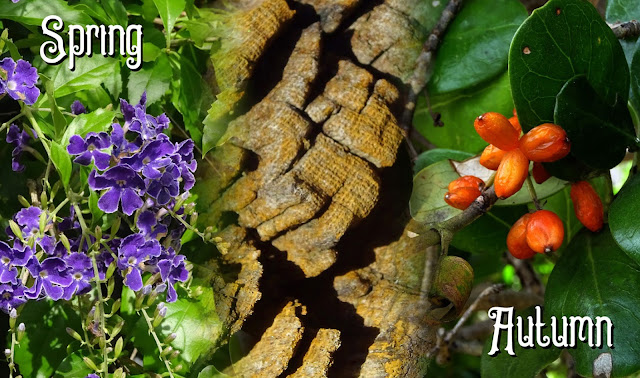
DESKTOP 3000 - SEASONS

Southern vs Northern Hemisphere, Spring vs Autumn! Flowers and seeds, an ascent into Summer and a descent into Winter. Enjoy the antipodean teasing, all in seasonal fun.

This post is part of the Mosaic Monday meme,
and also part of the Blue Monday meme,
and also part of the Seasons meme.


Thursday, 22 July 2021

DESKTOP 2912 - WARABURRA

Hardenbergia violacea is a species of flowering plant in the pea family Fabaceae, native to Australia from Queensland to Tasmania. It is known in Australia by the common names false sarsaparilla, purple coral pea, happy wanderer, native lilac and waraburra (which comes from the Kattang language). Elsewhere it is also called vine lilac or lilac vine.

It is a vigorous evergreen climber growing to 6 m or more, sometimes growing as a subshrub. It has typical pea-like flowers which are usually violet but can be white, pink or other colours. The leaves are dark green, "hard" and leathery, with prominent venation. H. violacea regrows from its roots after fire. The roots were experimented with by early European settlers as a substitute for sarsaparilla.

This post is part of the Floral Friday Fotos meme.


Thursday, 11 March 2021

DESKTOP 2779 - DURANTA

Duranta erecta is a species of flowering shrub in the verbena family Verbenaceae, native from Mexico to South America and the Caribbean. It is widely cultivated as an ornamental plant in tropical and subtropical gardens throughout the world, and has become naturalised in many places. It is considered an invasive species in Australia, China, South Africa and on several Pacific Islands.

The genus name is in honour of Castore Durante, a fifteenth-century Italian botanist. The specific epithet erecta means "upright" in Latin. The plant is also known as D. repens, from the Latin for "creeping". The latter name was originally used to identify smaller-leaved varieties of the species. Common names include golden dewdrop, pigeon berry, and skyflower. In Mexico, the native Nahuatl name for the plant is xcambocoché. In Tonga it is known as mavaetangi (tears of departure).

Duranta is registered as an invasive weed by many councils of Australia. It is a prolific, fast growing weed that is spread by birds from domestic areas to natural reserves. It was introduced and marketed as a hedge plant some years ago. Many people now fight to keep this thorny pest under control. It is highly ranked in the most invasive weeds in Australia.

Duranta erecta is a sprawling shrub or (infrequently) a small tree. It can grow to 6 m tall and can spread to an equal width. Mature specimens possess axillary thorns, which are often absent on younger specimens. The leaves are light green, elliptic to ovate, opposite, and grow up to 7.5 cm long and 3.5 cm broad, with a 1.5 cm petiole. The flowers are light-blue or lavender, produced in tight clusters located on terminal and axillary stems, blooming almost all year long. 

The fruit is a small globose yellow or orange berry, up to 11 mm diameter and containing several seeds. The leaves and berries of the plant are toxic, and are confirmed to have killed children, dogs and cats. However, songbirds eat the fruit without ill effects. The cultivar illustrated is the hybrid "China Girl".

This post is part of the Floral Friday Fotos meme.


Monday, 11 November 2019

Wednesday, 4 September 2019

DESKTOP 2225 - IRIS

Iris is a genus of about 300 species of flowering plants with showy flowers. It takes its name from the ancient Greek goddess of the rainbow, Iris, referring to the wide variety of flower colours found among the many species. As well as being the scientific name, iris is also very widely used as a common name for all Iris species, though some plants called thus belong to other closely related genera. A common name for some species is 'flags', while the plants of the subgenus Scorpiris are widely known as 'junos', particularly in horticulture. 

It is a popular garden flower and its blossoms provide wonderful splashes of colour in the Spring garden. The genus is widely distributed throughout the north temperate zone. Their habitats are varied, ranging from cold and montane regions to the grassy slopes, meadowlands and riverbanks of Europe, the Middle East and northern Africa, Asia and across North America. Irises are perennial herbs, growing from creeping rhizomes (rhizomatous irises) or, in drier climates, from bulbs (bulbous irises). They have long, erect flowering stems which may be simple or branched, solid or hollow, and flattened or have a circular cross-section. The rhizomatous species usually have 3–10 basal sword-shaped leaves growing in dense clumps. The bulbous species have cylindrical, basal leaves.

This post is part of the Wordless Wednesday meme,
and also part of the ABC Wednesday meme.

Thursday, 29 August 2019

DESKTOP 2219 - WINTER IRIS

Iris unguicularis (also commonly known as the Algerian iris or Winter iris) is a rhizomatous flowering plant in the genus Iris, native to Greece, Turkey, Western Syria, and Tunisia. It grows to 30 centimetres, with grassy evergreen leaves, producing pale lilac or purple flowers with a central band of yellow on the falls. The flowers appear in winter and early spring.

They are fragrant, with pronounced perianth tubes up to 20 cm long. This plant is widely cultivated in temperate regions, and numerous cultivars have been selected for garden use, including a slightly more tender white form 'Alba', and a dwarf variety I. unguicularis subsp. cretensis. The cultivar 'Mary Barnard' has gained the Royal Horticultural Society's Award of Garden Merit.

This post is part of the Floral Friday Fotos meme.

Tuesday, 23 July 2019

DESKTOP 2182 - GOLDEN TEMPLE, INDIA

Sri Harmandir Sahib (The abode of God), also Sri Darbar Sahib and informally referred to as the “Golden Temple”, is the holiest Gurdwara (place of worship) of Sikhism, located in the city of Amritsar, Punjab, India. Amritsar (literally, the tank of nectar of immortality) was founded in 1577 by the fourth Sikh guru, Guru Ram Das. The fifth Sikh Guru, Guru Arjan, designed the Harmandir Sahib to be built in the centre of this holy tank, and upon its construction, installed the Adi Granth, the holy scripture of Sikhism, inside the Harmandir Sahib.

The Harmandir Sahib complex is also home to the Akal Takht (the throne of the timeless one, constituted by the Sixth Guru, Guru Hargobind). While the Harmandir Sahib is regarded as the abode of God's spiritual attribute, the Akal Takht is the seat of God's temporal authority. The construction of Harmandir Sahib was intended to build a place of worship for men and women from all walks of life and all religions to come and worship God equally. Accordingly, as a gesture of this non-sectarian universalness of Sikhism, Guru Arjan had specially invited Muslim Sufi saint, Hazrat Mian Mir to lay the foundation stone of the Harmandir Sahib. The four entrances (representing the four directions) to get into the Harmandir Sahib also symbolise the openness of the Sikhs towards all people and religions.

Over 100,000 people visit the holy shrine daily for worship, and also partake jointly in the free community kitchen and meal (Langar) regardless of any distinctions, a tradition that is a hallmark of all Sikh Gurdwaras. The present-day gurdwara was renovated in 1764 by Jassa Singh Ahluwalia with the help of other Sikh Misls. In the early nineteenth century, Maharaja Ranjit Singh secured the Punjab region from outside attack and covered the upper floors of the gurdwara with gold, which gives it its distinctive appearance and its English name.

This post is part of the Our World Tuesday meme,
and also part of the Travel Tuesday meme,
and also part of the Wordless Wednesday meme.

Saturday, 16 June 2018

DESKTOP 1781 - CRIMSON ROSELLA

The Crimson Rosella (Platycercus elegans) is a parrot native to eastern and south eastern Australia which has been introduced to New Zealand and Norfolk Island. It is commonly found in, but not restricted to, mountain forests and gardens. The species as it now stands has subsumed two former separate species, the yellow rosella and the Adelaide rosella. Molecular studies show one of the three red-coloured races, var. nigrescens is genetically more distinct.

This post is part of the Saturday Critters meme,
and also part of the Camera Critters meme,
and also part of the I'd Rather Be Birdin' meme.

Saturday, 26 May 2018

DESKTOP 1760 - BUTTERFLY

Vanessa kershawi, commonly known as the Australian Painted Lady, is a butterfly that is mostly confined to Australia, although westerly winds have dispersed it to islands east of Australia, including New Zealand. There is debate surrounding the taxonomy of this species. Some believe that the Australian Painted Lady should be a subspecies to the Painted Lady due to the similarity in lifestyle and behaviour. Furthermore, the Painted Lady is found around the globe but Australia is the only location in which it varies enough to be considered a separate species. However, due to the distinct genitalia of the males, and variation in coloration, many others consider the Australian Painted Lady to be a separate species. 

During spring, adult butterflies migrate south in large numbers from northern states of Queensland and New South Wales. In order to find mates, male Australian Painted Ladies exhibit territorial behaviour, which involves a male perching on vegetation in a sunny spot on a hilltop, waiting for females to fly by. Despite urbanisation and invasive plants altering its habitat, populations of Australian Painted Ladies have not been significantly impacted by these changes.

This post is part of the Saturday Critters meme,
and also part of the Camera Critters meme.

Wednesday, 13 December 2017

DESKTOP 1597 - WOOL

Woolly thoughts make the warmest white wraps for Winter!

This post is part of the Wordless Wednesday meme,
and also part of the ABC Wednesday meme.

Thursday, 30 November 2017

DESKTOP 1584 - SOCIETY GARLIC

Tulbaghia violacea, also known as society garlic or pink agapanthus, is a species of flowering plant in the onion family Alliaceae, indigenous to southern Africa (KwaZulu-Natal and Cape Province), and reportedly naturalised in Tanzania and Mexico.

Growing to 60 cm tall by 25 cm wide, it is a clump-forming perennial with narrow leaves and large clusters of fragrant, lilac flowers from midsummer to autumn. When grown as an ornamental, this plant requires some protection from winter frosts. It has gained the Royal Horticultural Society's Award of Garden Merit.

This post is part of the Floral Friday Fotos meme.

Thursday, 24 August 2017

DESKTOP 1486 - LILAC HIBISCUS

Alyogyne huegelii is a flowering plant in the Malvaceae family, found in the Southwest botanical province of Western Australia, extending along its entire coastline. A large flowered shrub, the species favours the sands of coastal shrublands and heath. The large flower, highly variable in colour, is similar to that of Hibiscus. It was previously placed in that genus, and is commonly named "Lilac Hibiscus".

It is widely cultivated as a flowering plant for the garden, but the varieties and cultivars previously published are no longer formally recognised. Alyogyne is a shrub to four metres with many alternate branches, although lower ones may be sparse. Bright green leaves are divided in three to five in outline; margins are irregular, lobate to toothed; pubescent and strongly veined lobes are coarse in shape. The flowerstalk at the leaf axil is long, tilting at the single flower.

The flowers have five luminous petals up to 70 mm long, these are overlapping and have slight ridges. The colour is cream or mauve, or the lilac of the name by which it is traded. The staminal tube structure contains numerous whorled anthers, these are yellow. The five styles of this are fused until the tip, which is composed of swollen and apparently divided stigma. This is supported on a five-lobed calyx, within an arrangement of up to 10 partly fused bracts.

As with all the Malvales, the flowers last around a day – becoming deeply coloured and papery when spent. They are numerous in the long flowering period in Australia being between June and January.

This post is part of the Floral Friday Fotos meme.

Thursday, 6 July 2017

DESKTOP 1437 - BACOPA

Sutera cordata 'Scopia Gulliver Blue' (sometimes known as Bacopa, or Chaenostoma cordatum), is a herbaceous annual with a trailing habit of growth, eventually spilling over the edges of hanging baskets and containers. Its relatively fine texture sets it apart from other garden plants with less refined foliage. This plant will require occasional maintenance and upkeep, and should not require much pruning, except when necessary, such as to remove dieback. It has no significant negative characteristics.

The plant grows to about 15 cm height and spreads over an area 50-60 cm in diameter. It is covered in stunning purple flowers with sky blue overtones and yellow eyes, along the stems from mid-spring to early winter. Its small serrated round leaves remain green in colour throughout the year. The fruit is not ornamentally significant.

Sutera cordata should only be grown in full sunlight. It does best in average to evenly moist conditions, but will not tolerate standing water. It is not particular as to soil type or pH. It is highly tolerant of urban pollution and will even thrive in inner city environments. It can be propagated by cuttings. It is a fine choice for the garden, but it is also a good selection for planting in outdoor containers and hanging baskets. Because of its trailing habit of growth, it is ideally suited for use as a 'spiller' in the 'spiller-thriller-filler' container combination; plant it near the edges where it can spill gracefully over the pot. Note that when growing plants in outdoor containers and baskets, they may require more frequent waterings than they would in the garden.

Although it's not a true annual, this fast-growing plant can be expected to behave as an annual if left outdoors over cold Winters, usually needing replacement the following year. As such, gardeners should take into consideration that it will perform differently than it would in its native habitat.

This post is part of the Floral Friday Fotos meme.

Thursday, 6 April 2017

DESKTOP 1346 - CALLA LILLIES

Zantedeschia is a genus of 8 species of herbaceous, perennial, flowering plants in the family Araceae, native to southern Africa from South Africa north to Malawi. The genus has been introduced on all continents except Antarctica. Common names include arum lily for Z. aethiopica and calla and calla lily for Z. elliottiana and Z. rehmannii, although members of the genus are neither true lilies of Liliaceae, true Arums, or true Callas (related genera in Araceae). The colourful flowers and leaves of both species and cultivars are greatly valued and commonly grown as ornamental plants.

This post is part of the Floral Friday Fotos meme.